Acta Phys. -Chim. Sin. ›› 2025, Vol. 41 ›› Issue (3): 100021.doi: 10.3866/PKU.WHXB202311005
Special Issue: Energy Chemistry
• REVIEW • Previous Articles Next Articles
Rational Design of Bimetallic Oxide Anodes for Superior Li+ Storage
Xueyu Lin1, Ruiqi Wang2,*( ), Wujie Dong3, Fuqiang Huang1,3,4,*()
- 1 College of Chemistry and Molecular Engineering, Beijing National Laboratory for Molecular Sciences, State Key Laboratory of Rare Earth Materials Chemistry and Applications, Peking University, Beijing 100871, China
2 School of Chemical Engineering, University of Chinese Academy of Sciences, Beijing 101408, China
3 State Key Laboratory of High Performance Ceramics and Superfine Microstructure, Shanghai Institute of Ceramics, Chinese Academy of Sciences, Shanghai 200050, China
4 State Key Lab of Metal Matrix Composites, School of Materials Science and Engineering, Shanghai Jiao Tong University, Shanghai 200240, China
-
Received:2023-11-03Revised:2023-12-08Accepted:2023-12-11Published:2024-01-02 -
Contact:Email: wangruiqi@ucas.ac.cn (Ruiqi Wang)huangfq@pku.edu.cn (Fuqiang Huang) -
Supported by:the National Natural Science Foundation of China(22005006)

Cite this article
Xueyu Lin, Ruiqi Wang, Wujie Dong, Fuqiang Huang. Rational Design of Bimetallic Oxide Anodes for Superior Li+ Storage[J]. Acta Phys. -Chim. Sin. 2025, 41(3), 100021. doi: 10.3866/PKU.WHXB202311005
share this article
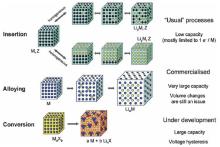
Fig 1
Comparison of different Li+ storage mechanisms of metal oxide anodes for lithium-ion batteries 7. Adapted with permission from Ref. 7, Copyright 2015, Wiley."
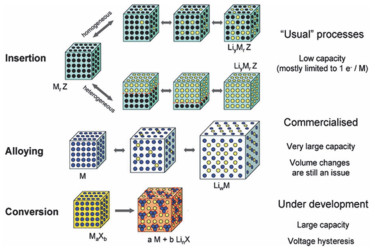
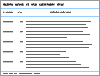
Table 1
Comparison of metal oxide anodes with different lithium-storage mechanisms 5, 7–32."
| Litdium storage mechanism | Oxide | Theoretical specific capacity (mAh·g−1) | Potential (V vs. Li+/Li) | Advantages | Drawbacks |
| Intercalation type | TiO2 | 335 | 1.75 | High structure stability, small volume change during litdium insertion, long cycle life, and excellent rate performance | Low tdeoretical specific capacity, high potential, and high cost |
| Li2Ti3O12 | 175 | 1.55 | |||
| Nb2O5 | 202 | 1.63 | |||
| V2O5 | 294 | 3.30 | |||
| Conversion type | MnO | 756 | 1.25 | High tdeoretical specific capacity | High potential, large volume expansion during litdium insertion, low initial coulombic efficiency, high polarization voltage and low energy efficiency |
| Fe2O3 | 1007 | 1.70 | |||
| CoO | 715 | 1.85 | |||
| NiO | 718 | 2.20 | |||
| Alloying type | Si | 4200 | 0.35 | High tdeoretical specific capacity, low potential | Large volume expansion during litdium insertion, low initial coulombic efficiency |
| Ge | 1624 | 0.30 | |||
| Sn | 994 | 0.50 | |||
| Sb | 660 | 0.90 | |||
| In | 1012 | 0.70 |
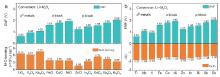
Fig 2
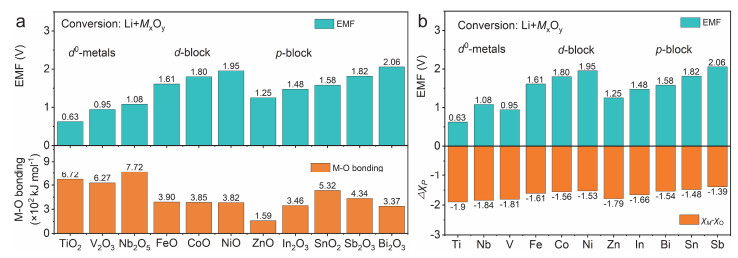
(a) Relationship between the EMF for conversion reaction of binary metal oxides and the corresponding M― O bond energy 39, 40; (b) relationship between the EMF for conversion reaction of binary metal oxides and the difference in electronegativity (∆χP) between the central metal M and O."
"
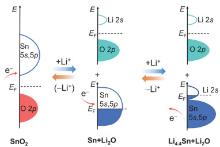
Fig 4
Band structure changes of conversion-alloying-type SnO2 during lithium insertion. The dash lines indicate the Fermi-level."
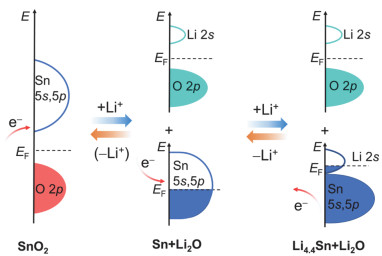
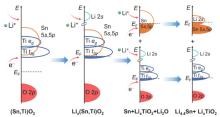
Fig 5
Schematic of lithium-storage mechanism for intercalation/alloying-type (Sn, Ti)O2 bimetallic oxide. Dash lines reveal the Fermi level."
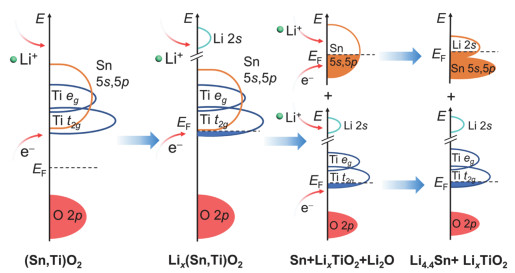
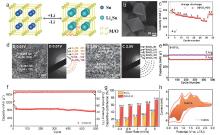
Fig 6
(a) Schematic of dispersing alloying-type Sn atoms in an intercalation-type framework, (b) SEM image of pyrochlore-type Ce2Sn2O7 49; (c) rate capability of SbVO4/rGO, (d) Ex situ TEM of bimetallic oxide SbVO4/rGO after discharging to 0.01 V and charging to 2.5 V, respectively 53; (e) long-term cycling performance of (Sn, Ti)O2 solid solution at high current density 48; (f) cycling performance of (In, V)2O3 solid solution at 10 A∙g−1, (g) capacity contributions from diffusion-controlled and capacitance behavior of (In, V)2O3 at different scan rates, (h) charge capacity contribution provided by capacitance behavior at a scan rate of 5 mV s−1 54. (a, b) Adapted with permission from Ref. 49, Copyright 2019, Royal of Society of Chemistry. (c, d) Adapted with permission from Ref. 53, Copyright 2019, Wiley. (e) Adapted with permission from Ref. 48, Copyright 2016, Royal of Society of Chemistry."
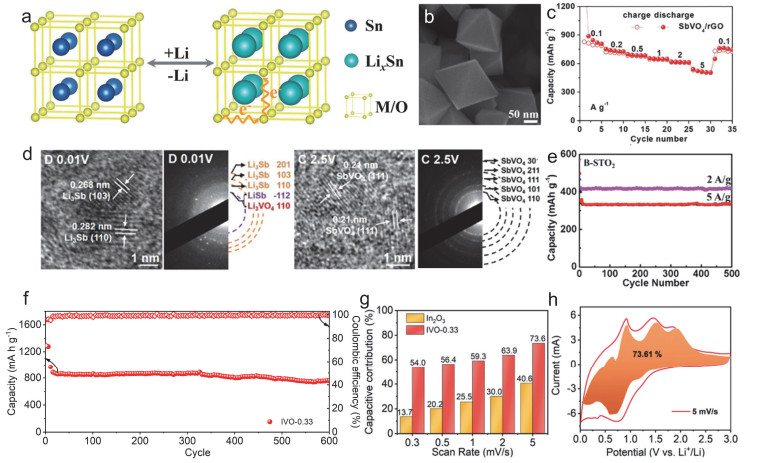
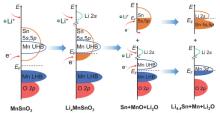
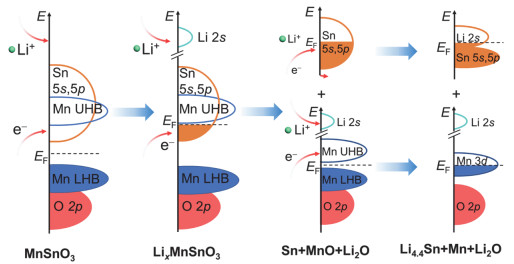
Fig 7
Schematic of lithium-storage mechanism for conversion/alloying-type MnSnO3. The dash lines indicate the Fermi level."
"
Fig 9
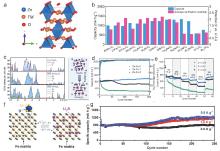
Lithium-storage mechanism for alloying-type bimetallic oxides: (a) crystal structure of Bi2Sn2O7, (b) comparison of activation energy for single-atom diffusion and heteroatom diffusion, (c) band structure changes of Bi2Sn2O7 during lithiation, (d) cycling performance of Bi2Sn2O7 at 2 A g−1, (e) comparison of lithium-storage performance among Bi2Sn2O7 and other conversion-alloying-type anodes at different current densities 68; (f) SEM image of hollow ZnSnO3 cube, (g) SEM image of hollow ZnSnO3@C cube, (h) TEM image of hollow ZnSnO3 cube, (i) TEM image of hollow ZnSnO3@C cube 70; (j) Ex situ XRD patterns of Zn2SnO4 at different potentials 69. (a–e) Adapted with permission from Ref. 68, Copyright 2022, Cell Press. (f–i) Adapted with permission from Ref. 70, Copyright 2019, Elsevier. (j) Adapted with permission from Ref. 69, Copyright 2011, Royal of Society of Chemistry."
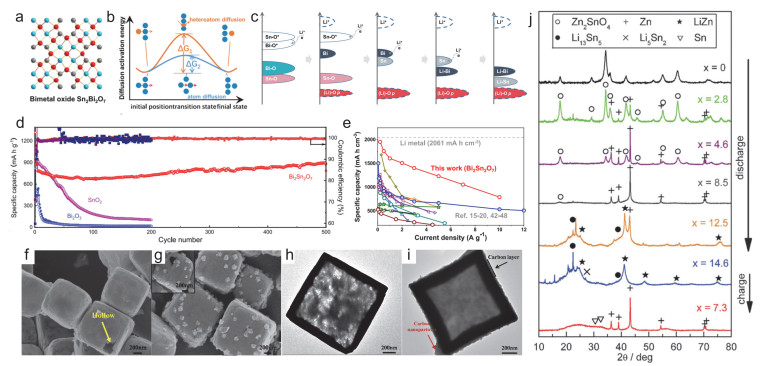
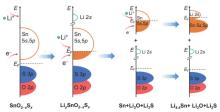
Fig 10
DOS changes of SnO2−xSx anode during lithiation. The dash lines indicate the Fermi level."
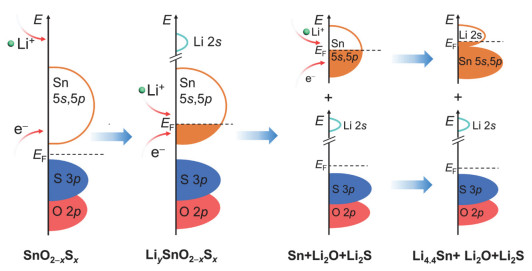
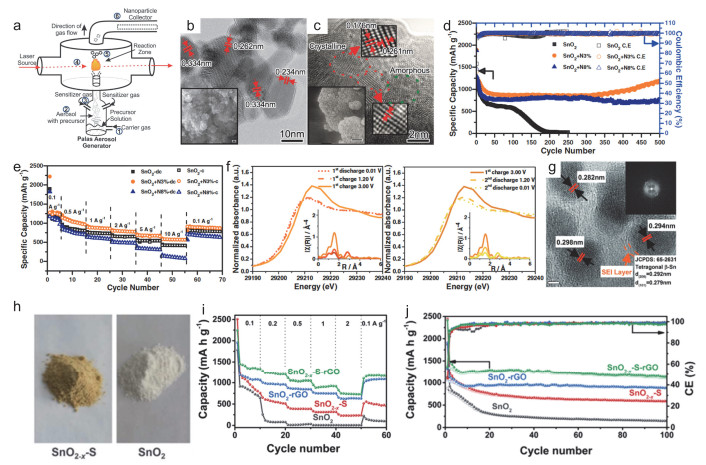
Fig 11
(a) Schematic of laser thermal decomposition synthesis of N-doped SnO2, (b) HRTEM image of SnO2 nanoparticles, (c) HRTEM image of SnO2-N3% nanoparticles, (d) cycling performance of N-doped SnO2 at 1.4 A g−1, (e) rate capability of N-doped SnO2, (f) changes in Sn K-edge X-ray absorption spectra (XAS) and X-ray absorption fine structure spectra (XAFS) of N-doped SnO2 during electrochemical reaction, (g) in situ HRTEM image of SnO2-N3% nanoparticles charged to 3.0 V after 100 cycles 77; (h) optical photograph of SnO2 and SnO2-S encapsulated in S, (i) rate capability of SnO2-S-rGO composite, (j) cycling performance of SnO2-S-rGO composite at 0.1 A g−1 79. (a–g) Adapted with permission from Ref. 77, Copyright 2016, Wiley. (h–j) Adapted with permission from Ref. 79, Copyright 2019, Royal of Society of Chemistry."
| 1 |
doi: 10.1002/aenm.202101650 |
| 2 |
doi: 10.3866/PKU.WHXB202204057 |
|
丁晓博; 黄倩晖; 熊训辉; 等. 物理化学学报, 2022, 38, 2204057.
doi: 10.3866/PKU.WHXB202204057 |
|
| 3 |
doi: 10.1021/acsami.6b04239 |
| 4 |
doi: 10.1038/s41560-018-0107-2 |
| 5 |
doi: 10.1016/j.enchem.2020.100045 |
| 6 |
doi: 10.1021/cr3001884 |
| 7 |
doi: 10.1002/aenm.201402225 |
| 8 |
doi: 10.1021/acsami.5b03395 |
| 9 |
doi: 10.1021/nl504038s |
| 10 |
doi: 10.1039/c4cp00855c |
| 11 |
doi: 10.1039/B819629J |
| 12 |
doi: 10.1002/aenm.201601825 |
| 13 |
doi: 10.1149/2.040405jes |
| 14 |
doi: 10.1016/j.jpowsour.2017.03.007 |
| 15 |
doi: 10.1039/C3TA13352D |
| 16 |
doi: 10.1039/C9TA03551F |
| 17 |
doi: 10.1039/D1EE02664J |
| 18 |
doi: 10.1039/C0JM03132A |
| 19 |
doi: 10.1016/j.jpowsour.2017.06.023 |
| 20 |
doi: 10.1007/s41918-018-0001-4 |
| 21 |
doi: 10.1002/adma.201805754 |
| 22 |
doi: 10.1039/C3TA01285A |
| 23 |
doi: 10.1039/C8CC03875A |
| 24 |
doi: 10.1021/acs.chemmater.7b03847 |
| 25 |
doi: 10.1039/c7cs00863e |
| 26 |
doi: 10.1002/ange.201811784 |
| 27 |
doi: 10.1016/j.jallcom.2015.01.292 |
| 28 |
doi: 10.1039/C2JM31364B |
| 29 |
doi: 10.1002/adfm.201802756 |
| 30 |
doi: 10.1016/j.jpowsour.2010.02.020 |
| 31 |
doi: 10.1039/C5TA00516G |
| 32 |
doi: 10.1021/acssuschemeng.7b01595 |
| 33 |
doi: 10.1016/j.chempr.2018.01.003 |
| 34 |
doi: 10.1038/natrevmats.2016.13 |
| 35 |
doi: 10.1021/acsenergylett.1c01145 |
| 36 |
doi: 10.1039/b919877f |
| 37 |
doi: 10.1002/smll.201903194 |
| 38 |
doi: 10.1021/acs.accounts.7b00487 |
| 39 |
doi: 10.1149/1.1801451 |
| 40 |
|
| 41 |
doi: 10.1021/jacs.0c02203 |
| 42 |
doi: 10.1002/smll.201904740 |
| 43 |
doi: 10.1002/adfm.201404348 |
| 44 |
doi: 10.1016/j.esci.2023.100158 |
| 45 |
doi: 10.1016/j.mser.2022.100713 |
| 46 |
doi: 10.1002/aenm.201902485 |
| 47 |
doi: 10.1002/adma.201700136 |
| 48 |
doi: 10.1039/C6TA05645H |
| 49 |
doi: 10.1039/C9TA13602A |
| 50 |
doi: 10.1002/anie.202004149 |
| 51 |
doi: 10.1016/j.cej.2019.03.020 |
| 52 |
doi: 10.1002/smtd.202000218 |
| 53 |
doi: 10.1002/smtd.201900231 |
| 54 |
doi: 10.1002/advs.202202026 |
| 55 |
doi: 10.1007/s40843-021-1783-0 |
| 56 |
doi: 10.1016/j.electacta.2016.08.022 |
| 57 |
doi: 10.1039/C6EE02346K |
| 58 |
doi: 10.1002/aenm.201502175 |
| 59 |
doi: 10.1002/smll.201905868 |
| 60 |
doi: 10.1002/adfm.201805723 |
| 61 |
doi: 10.1039/C7TA05798A |
| 62 |
doi: 10.1021/acsami.9b08539 |
| 63 |
doi: 10.3866/PKU.WHXB201612222 |
|
甄绪; 郭雪静. 物理化学学报, 2017, 33, 845d.
doi: 10.3866/PKU.WHXB201612222 |
|
| 64 |
doi: 10.1021/acsnano.8b00168 |
| 65 |
doi: 10.1039/C3TA13228E |
| 66 |
doi: 10.1016/j.jpowsour.2017.05.104 |
| 67 |
doi: 10.1002/adma.201801409 |
| 68 |
doi: 10.1016/j.xcrp.2022.101109 |
| 69 |
doi: 10.1039/C1CP22298H |
| 70 |
doi: 10.1016/j.electacta.2019.04.167 |
| 71 |
doi: 10.1039/C2EE21580B |
| 72 |
doi: 10.1021/am301664e |
| 73 |
doi: 10.1039/C9NR03641E |
| 74 |
doi: 10.1016/j.electacta.2016.07.076 |
| 75 |
doi: 10.1039/C5TA04175A |
| 76 |
doi: 10.1021/acsmaterialslett.2c00810 |
| 77 |
doi: 10.1002/adma.201603286 |
| 78 |
doi: 10.1016/j.jpowsour.2014.08.084 |
| 79 |
doi: 10.1039/C9TA11330D |
| 80 |
doi: 10.1149/1.3532037 |
| 81 |
Kwon, C.; Kim, H.; Toupance, T.; Jousseaume, B.; Campet, G.; Fluorine-Doped Tin Oxide Electrods for Lithium Batteries. In Fluorinated Materials for Energy Conversion; Elsevier: The Netherlands, 2005; p. 103.
|
| 82 |
doi: 10.1016/j.jpowsour.2017.07.024 |
| 83 |
doi: 10.1021/acsaem.1c01883 |
| [1] | Xintong Zhu, Bin Cao, Chong Yan, Cheng Tang, Aibing Chen, Qiang Zhang. Advances in coating strategies for graphite anodes in lithium-ion batteries [J]. Acta Phys. -Chim. Sin., 2025, 41(9): 100096-. |
| [2] | Liangliang Song, Haoyan Liang, Shunqing Li, Bao Qiu, Zhaoping Liu. Challenges and strategies on high-manganese Li-rich layered oxide cathodes for ultrahigh-energy-density batteries [J]. Acta Phys. -Chim. Sin., 2025, 41(8): 100085-. |
| [3] | Aoyu Huang, Jun Xu, Yu Huang, Gui Chu, Mao Wang, Lili Wang, Yongqi Sun, Zhen Jiang, Xiaobo Zhu. Tailoring Electrode-Electrolyte Interfaces via a Simple Slurry Additive for Stable High-Voltage Lithium-Ion Batteries [J]. Acta Phys. -Chim. Sin., 2025, 41(4): 100037-. |
| [4] | Yu Guo, Zhiwei Huang, Yuqing Hu, Junzhe Li, Jie Xu. Recent Advances in Iron-based Heterostructure Anode Materials for Sodium Ion Batteries [J]. Acta Phys. -Chim. Sin., 2025, 41(3): 100022-. |
| [5] | Chenyue Huang, Hongfei Zheng, Ning Qin, Canpei Wang, Liguang Wang, Jun Lu. Single-Crystal Nickel-Rich Cathode Materials: Challenges and Strategies [J]. Acta Phys. -Chim. Sin., 2024, 40(9): 2308051-. |
| [6] | Jingshuo Zhang, Yue Zhai, Ziyun Zhao, Jiaxing He, Wei Wei, Jing Xiao, Shichao Wu, Quan-Hong Yang. Research Progress of Functional Binders in Silicon-Based Anodes for Lithium-Ion Batteries [J]. Acta Phys. -Chim. Sin., 2024, 40(6): 2306006-. |
| [7] | Xuechen Hu, Qiuying Xia, Fan Yue, Xinyi He, Zhenghao Mei, Jinshi Wang, Hui Xia, Xiaodong Huang. Electrochemical Characteristics of LiNbO3 Anode Film and Its Applications in All-Solid-State Thin-Film Lithium-Ion Battery [J]. Acta Phys. -Chim. Sin., 2024, 40(2): 2309046-. |
| [8] | Siyu Zhang, Kunhong Gu, Bing'an Lu, Junwei Han, Jiang Zhou. Hydrometallurgical Processes on Recycling of Spent Lithium-lon Battery Cathode: Advances and Applications in Sustainable Technologies [J]. Acta Phys. -Chim. Sin., 2024, 40(10): 2309028-. |
| [9] | Hangyu Lu, Ruilin Hou, Shiyong Chu, Haoshen Zhou, Shaohua Guo. Progress on Modification Strategies of Layered Lithium-Rich Cathode Materials for High Energy Lithium-Ion Batteries [J]. Acta Phys. -Chim. Sin., 2023, 39(7): 2211057-0. |
| [10] | Ru Wang, Zhikang Liu, Chao Yan, Long Qie, Yunhui Huang. Interface Strengthening of Composite Current Collectors for High-Safety Lithium-Ion Batteries [J]. Acta Phys. -Chim. Sin., 2023, 39(2): 2203043-0. |
| [11] | Siying Zhu, Huiyang Li, Zhongli Hu, Qiaobao Zhang, Jinbao Zhao, Li Zhang. Research Progresses on Structural Optimization and Interfacial Modification of Silicon Monoxide Anode for Lithium-Ion Battery [J]. Acta Phys. -Chim. Sin., 2022, 38(6): 2103052-. |
| [12] | Yue Yang, Jiawei Zhu, Pengyan Wang, Haimi Liu, Weihao Zeng, Lei Chen, Zhixiang Chen, Shichun Mu. NH2-MIL-125 (Ti) Derived Flower-Like Fine TiO2 Nanoparticles Implanted in N-doped Porous Carbon as an Anode with High Activity and Long Cycle Life for Lithium-Ion Batteries [J]. Acta Phys. -Chim. Sin., 2022, 38(6): 2106002-. |
| [13] | Ying Mo, Kuikui Xiao, Jianfang Wu, Hui Liu, Aiping Hu, Peng Gao, Jilei Liu. Lithium-Ion Battery Separator: Functional Modification and Characterization [J]. Acta Phys. -Chim. Sin., 2022, 38(6): 2107030-. |
| [14] | Xuewei Liu, Ying Niu, Ruixiong Cao, Xiaohong Chen, Hongyan Shang, Huaihe Song. Is there a Demand of Conducting Agent of Acetylene Black for Graphene-Wrapped Natural Spherical Graphite as Anode Material for Lithium-Ion Batteries? [J]. Acta Phys. -Chim. Sin., 2022, 38(2): 2012062-. |
| [15] | Yaokun Ye, Zongxiang Hu, Jiahua Liu, Weicheng Lin, Taowen Chen, Jiaxin Zheng, Feng Pan. Research Progress of Theoretical Studies on Polarons in Cathode Materials of Lithium-Ion Batteries [J]. Acta Phys. -Chim. Sin., 2021, 37(11): 2011003-. |
|
||