Acta Phys. -Chim. Sin. ›› 2024, Vol. 40 ›› Issue (9): 2306007.doi: 10.3866/PKU.WHXB202306007
Special Issue: Frontiers in Electrochemistry
• ARTICLE • Previous Articles Next Articles
Nickel-Vanadium Layered Double Hydroxides for Efficient and Scalable Electrooxidation of 5-Hydroxymethylfurfural Coupled with Hydrogen Generation
Meiran Li1, Yingjie Song1, Xin Wan1, Yang Li1, Yiqi Luo1, Yeheng He2, Bowen Xia2, Hua Zhou1,3,*( ), Mingfei Shao1,3,*()
- 1 State Key Laboratory of Chemical Resource Engineering, College of Chemistry, Beijing University of Chemical Technology, Beijing 100029, China
2 PetroChina Petrochemical Research Institute, China National Petroleum Corporation, Beijing 100195, China
3 Quzhou Institute for Innovation in Resource Chemical Engineering, Quzhou 324000, Zhejiang Province, China
-
Received:2023-06-02Revised:2023-07-07Accepted:2023-07-20Published:2023-08-07 -
Contact:Email: hzhou@buct.edu.cn (Hua Zhou)shaomf@mail.buct.edu.cn (Mingfei Shao) -
Supported by:the National Natural Science Foundation of China(22090030); the National Natural Science Foundation of China(22090031); the National Natural Science Foundation of China(22288102); the Fundamental Research Funds for the Central Universities(buctrc202211)

Cite this article
Meiran Li, Yingjie Song, Xin Wan, Yang Li, Yiqi Luo, Yeheng He, Bowen Xia, Hua Zhou, Mingfei Shao. Nickel-Vanadium Layered Double Hydroxides for Efficient and Scalable Electrooxidation of 5-Hydroxymethylfurfural Coupled with Hydrogen Generation[J]. Acta Phys. -Chim. Sin. 2024, 40(9), 2306007. doi: 10.3866/PKU.WHXB202306007
share this article
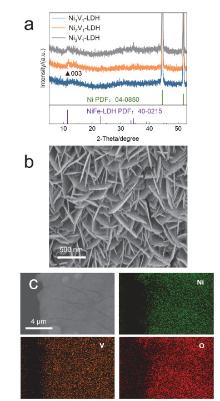
Fig 1
Characterization of NiV-LDHs. (a) XRD patterns of NiV-LDHs. SEM image (b) and corresponding EDS mapping (c) of small-sized Ni1V1-LDH (3 cm × 5 cm)."
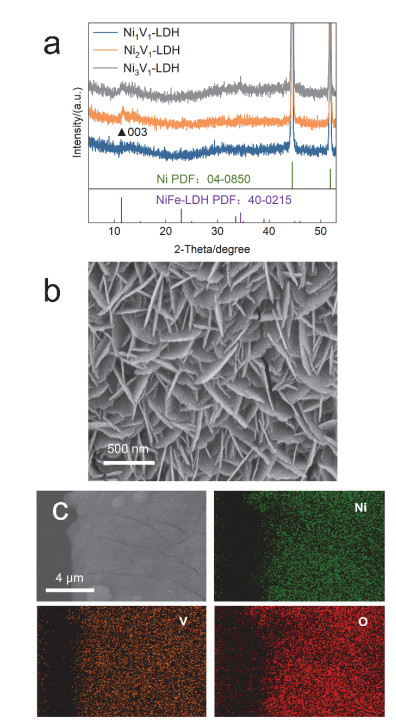
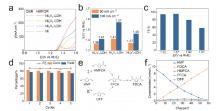
Fig 2
(a) LSV curves of NiV-LDHs for OER and HMFOR without iR compensation. (b) HMF oxidation potential at current densities of 50 and 100 mA·cm−2. (c) FE of FDCA under different potentials. (d) Recycling experiments at 1.57 V vs. RHE. (e) Reaction pathways of HMFOR. (f) Concentrations of HMF and the oxidation products as a function of charge transfer. Ni1V1-LDH was used as the anodic catalyst for electrochemical tests in Fig. 2b–f."
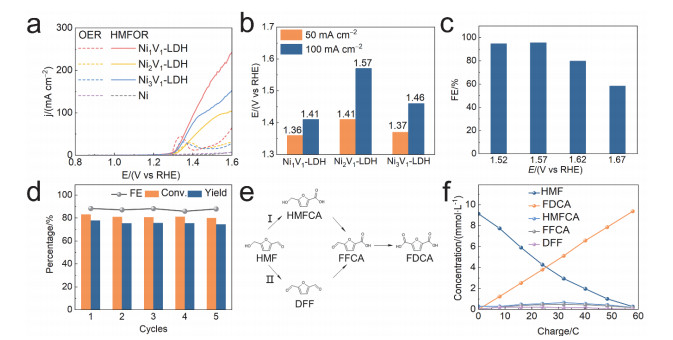
Fig 3
Two-electrode experiments. (a) LSV curves for water electrolysis and HMF electrooxidation with 90% iR compensation. (b) H2 evolution as a function of reaction time in water electrolysis and HMF electrooxidation at 2 V of cell voltage without iR."
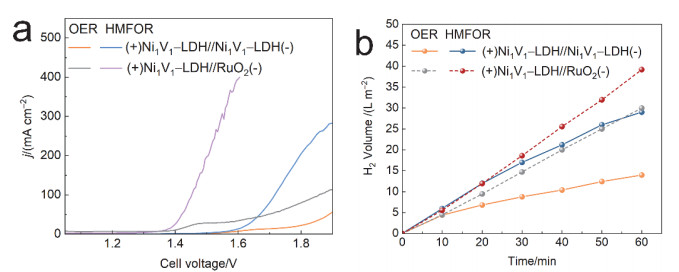
Fig 4
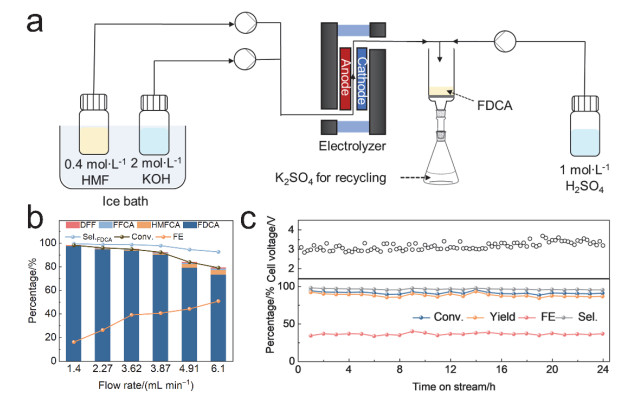
(a) Illustration of the flow reactor system for continuously HMF electrooxidation to FDCA. (b) Catalytic performances of HMFOR as a function of flow rate at a constant current of 10 A. (c) Performances of HMFOR during 24 h at a flow rate of 3.62 mL∙min−1 at 10 A."
| 1 |
doi: 10.1038/s41563-020-0788-3 |
| 2 |
doi: 10.1002/adma.202007056 |
| 3 |
|
|
王奥琦; 陈军; 张鹏飞; 唐珊; 冯兆池; 姚婷婷; 李灿. 物理化学学报, 2023, 39 (4), 2301023.
doi: 10.3866/PKU.WHXB202301023 |
|
| 4 |
|
|
徐斯然; 吴奇; 卢帮安; 唐堂; 张佳楠; 胡劲松. 物理化学学报, 2023, 39 (2), 2209001.
doi: 10.3866/PKU.WHXB202209001 |
|
| 5 |
doi: 10.1038/s41560-019-0374-6 |
| 6 |
doi: 10.1002/anie.202012066 |
| 7 |
doi: 10.1038/s41929-018-0083-8 |
| 8 |
doi: 10.1021/jacs.6b07127 |
| 9 |
doi: 10.1002/EXP.20210050 |
| 10 |
doi: 10.1038/s41929-021-00721-y |
| 11 |
doi: 10.1002/anie.201807717 |
| 12 |
doi: 10.1021/jacs.2c11153 |
| 13 |
Lin, K.; Xia, A.; Huang, Y.; Zhu, X.; Zhu, X.; Cai, K.; Wei, Z.; Liao, Q. 2023, 374, 128775. doi: 10.1016/j.biortech.2023.128775
|
| 14 |
doi: 10.1039/D2GC02965K |
| 15 |
|
|
滕嘉楠; 许光月; 傅尧. 物理化学学报, 2022, 38 (10), 2204031.
doi: 10.3866/PKU.WHXB202204031 |
|
| 16 |
|
|
郑书逸; 吴佳; 王可; 胡梦晨; 文欢; 尹诗斌. 物理化学学报, 2023, 39, 2301032.
doi: 10.3866/PKU.WHXB202301032 |
|
| 17 |
doi: 10.1038/s41467-022-31484-0 |
| 18 |
doi: 10.1016/j.apcatb.2022.121400 |
| 19 |
|
|
杨艳; 何博文; 马华隆; 杨森; 任州宏; 秦天; 卢发贵; 任力闻; 张熠霄; 王天富; 等. 物理化学学报, 2022, 38 (12), 2201050.
doi: 10.3866/PKU.WHXB202201050 |
|
| 20 |
doi: 10.1021/acscatal.8b01017 |
| 21 |
doi: 10.1016/j.chempr.2020.07.022 |
| 22 |
doi: 10.1016/j.apcatb.2021.120669 |
| 23 |
doi: 10.1039/d1gc00901j |
| 24 |
doi: 10.1039/c9gc03698a |
| 25 |
doi: 10.1002/adma.202000455 |
| 26 |
doi: 10.1002/adfm.201202825 |
| 27 |
doi: 10.1016/j.chempr.2018.06.007 |
| 28 |
|
|
刘瑶钰; 王宇辰; 严凯. 物理化学学报, 2023, 39 (2), 2205028.
doi: 10.3866/PKU.WHXB202205028 |
|
| 29 |
doi: 10.1021/acscatal.0c00007 |
| 30 |
doi: 10.1002/anie.201915803 |
| 31 |
doi: 10.1021/acscatal.1c05813 |
| 32 |
doi: 10.1002/anie.202007767 |
| 33 |
doi: 10.1002/anie.201908722 |
| 34 |
doi: 10.1002/anie.202219048 |
| 35 |
doi: 10.1002/anie.202215804 |
| 36 |
doi: 10.1002/open.202100072 |
| 37 |
doi: 10.1039/d2gc04732b |
| [1] | Lina Guo, Ruizhe Li, Chuang Sun, Xiaoli Luo, Yiqiu Shi, Hong Yuan, Shuxin Ouyang, Tierui Zhang. Effect of Interlayer Anions in Layered Double Hydroxides on the Photothermocatalytic CO2 Methanation of Derived Ni-Al2O3 Catalysts [J]. Acta Phys. -Chim. Sin., 2025, 41(1): 100002-. |
| [2] | Xinxuan Duan, Marshet Getaye Sendeku, Daoming Zhang, Daojin Zhou, Lijun Xu, Xueqing Gao, Aibing Chen, Yun Kuang, Xiaoming Sun. Tungsten-Doped NiFe-Layered Double Hydroxides as Efficient Oxygen Evolution Catalysts [J]. Acta Phys. -Chim. Sin., 2024, 40(1): 2303055-. |
| [3] | Yaoyu Liu, Yuchen Wang, Biying Liu, Mahmoud Amer, Kai Yan. Cobalt-Vanadium Layered Double Hydroxides Nanosheets as High-Performance Electrocatalysts for Urea Oxidation Reaction [J]. Acta Phys. -Chim. Sin., 2023, 39(2): 2205028-0. |
| [4] | Shuyi Zheng, Jia Wu, Ke Wang, Mengchen Hu, Huan Wen, Shibin Yin. Electronic Modulation of Ni-Mo-O Porous Nanorods by Co Doping for Selective Oxidation of 5-Hydroxymethylfurfural Coupled with Hydrogen Evolution [J]. Acta Phys. -Chim. Sin., 2023, 39(12): 2301032-. |
| [5] | Yan Yang, Bowen He, Hualong Ma, Sen Yang, Zhouhong Ren, Tian Qin, Fagui Lu, Liwen Ren, Yixiao Zhang, Tianfu Wang, Xi Liu, Liwei Chen. PtRuAgCoNi High-Entropy Alloy Nanoparticles for High-Efficiency Electrocatalytic Oxidation of 5-Hydroxymethylfurfural [J]. Acta Phys. -Chim. Sin., 2022, 38(12): 2201050-. |
| [6] | Jianan Teng, Guangyue Xu, Yao Fu. Aerobic Oxidation of 5-Hydroxymethylfurfural to Dimethyl Furan-2, 5-dicarboxylate over CoMn@NC Catalysts Using Atmospheric Oxygen [J]. Acta Phys. -Chim. Sin., 2022, 38(10): 2204031-. |
| [7] | Shaopeng Li, Jing Du, Bin Zhang, Yanzhen Liu, Qingqing Mei, Qinglei Meng, Minghua Dong, Juan Du, Zhijuan Zhao, Lirong Zheng, Buxing Han, Meiting Zhao, Huizhen Liu. Selective Hydrogenation of 5-(Hydroxymethyl)furfural to 5-Methylfurfural by Exploiting the Synergy between Steric Hindrance and Hydrogen Spillover [J]. Acta Phys. -Chim. Sin., 2022, 38(10): 2206019-. |
| [8] | Yan Li, Xingsheng Hu, Jingwei Huang, Lei Wang, Houde She, Qizhao Wang. Development of Iron-Based Heterogeneous Cocatalysts for Photoelectrochemical Water Oxidation [J]. Acta Phys. -Chim. Sin., 2021, 37(8): 2009022-. |
| [9] | Han Li, Fang Li, Jiaguo Yu, Shaowen Cao. 2D/2D FeNi-LDH/g-C3N4 Hybrid Photocatalyst for Enhanced CO2 Photoreduction [J]. Acta Phys. -Chim. Sin., 2021, 37(8): 2010073-. |
| [10] | Tian Li, Xiaojie Hao, Sha Bai, Yufei Zhao, Yu-Fei Song. Controllable Synthesis and Scale-up Production Prospect of Monolayer Layered Double Hydroxide Nanosheets [J]. Acta Phys. -Chim. Sin., 2020, 36(9): 1912005-. |
| [11] | Yu Guiyun,Hu Fengxian,Cheng Weiwei,Han Zitong,Liu Chao,Dai Yong. ZnCuAl-LDH/Bi2MoO6 Nanocomposites with Improved Visible Light-Driven Photocatalytic Degradation [J]. Acta Physico-Chimica Sinica, 2020, 36(7): 1911016-. |
| [12] | Hai-Yan WANG, Gao-Quan SHI. Layered Double Hydroxide/Graphene Composites and Their Applications for Energy Storage and Conversion [J]. Acta Physico-Chimica Sinica, 2018, 34(1): 22-35. |
| [13] | Jie-Xiang LIU,Ji-Hui REN,Qiao ZHAO,Ting-Jing SHI,Zhi-Fang LIU,Zhao LUO,Xiao-Guang ZHANG. Preparation and Characterization of Chlorpyrifos/Cyclodextrin Complex Intercalation into ZnAl-Layered Double Hydroxide [J]. Acta Phys. -Chim. Sin., 2016, 32(2): 558-564. |
| [14] | ZHAO Ji-Kuan, XIE Yan-Fang, XU Jie, HOU Wan-Guo. Preparation of Mg2Al Layered Double Hydroxide Nanosheets from Triton X-100 Hexagonal Lyotropic Liquid Crystal and Their Application as Drug Carriers [J]. Acta Phys. -Chim. Sin., 2015, 31(6): 1199-1206. |
| [15] | ZHANG Xiao-Qing, XU Yan YAN, YANG Chun-Hui, ZHANG Yan-Ping, YIN Yong-Xiang, SHANG Shu-Yong. In-situ Co-Precipitation of Ni-Mg-Al-LDH Catalytic Precursor on γ-Al2O3 for Dry Reforming of Methane: Synthesis and Evaluation [J]. Acta Phys. -Chim. Sin., 2015, 31(5): 948-954. |
|
||