Acta Phys. -Chim. Sin. ›› 2025, Vol. 41 ›› Issue (8): 100087.doi: 10.1016/j.actphy.2025.100087
• ARTICLE • Previous Articles Next Articles
Tailored cathode electrolyte interphase via ethylene carbonate-free electrolytes enabling stable and wide-temperature operation of high-voltage LiCoO2
Yu Peng, Jiawei Chen, Yue Yin, Yongjie Cao, Mochou Liao, Congxiao Wang, Xiaoli Dong*( ), Yongyao Xia*()
- Department of Chemistry, Shanghai Key Laboratory of Molecular Catalysis and Innovative Materials, Institute of New Energy, iChEM (Collaborative Innovation Center of Chemistry for Energy Materials), Fudan University, Shanghai 200433, China
-
Received:2025-02-19Revised:2025-03-18Accepted:2025-04-02Published:2025-06-07 -
Contact:Email: xldong@fudan.edu.cn (Xiaoli Dong)yyxia@fudan.edu.cn (Yongyao Xia) -
Supported by:the National Natural Science Foundation of China(21935003)

Cite this article
Yu Peng, Jiawei Chen, Yue Yin, Yongjie Cao, Mochou Liao, Congxiao Wang, Xiaoli Dong, Yongyao Xia. Tailored cathode electrolyte interphase via ethylene carbonate-free electrolytes enabling stable and wide-temperature operation of high-voltage LiCoO2[J]. Acta Phys. -Chim. Sin. 2025, 41(8), 100087. doi: 10.1016/j.actphy.2025.100087
share this article
Fig 1
(a) Chemical structures and HOMO energy level diagrams of salts, solvents, and additive. (b) LSV profiles of Li||Al cells with ED and PFB electrolytes at a constant scan rate of 0.1 mV·s−1. (c) CV curves for Li||LCO half cells with ED and PFB electrolytes (3.0–4.6 V, 0.1 mV·s−1)."
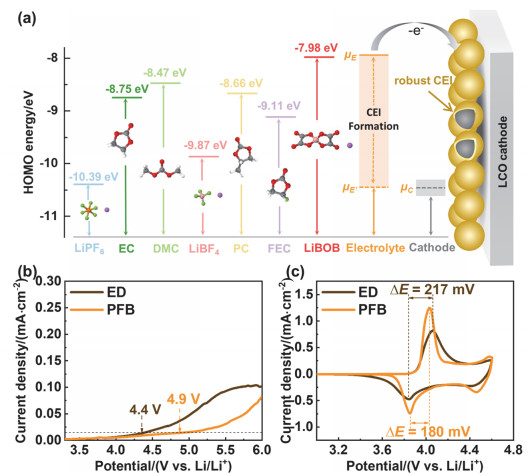
Fig 2
Electrochemical performances of Li||LCO half cells using different electrolytes. (a) The rate performance of LCO cathode with ED, PF, and PFB electrolytes. (b) Charge and discharge curves of the GITT measurements conducted after first cycle, and the corresponding Li+ diffusion coefficient (DLi+) during (c) charging and (d) discharging in different electrolytes. (e) Cycling performance of Li||LCO half cells at 0.5C in the voltage range of 3.0–4.6 V. (f–h) The charge and discharge curves of the 1st cycle and the 50th cycle and voltage decay comparison of Li||LCO half cells at 0.5C under cut-off voltage of 4.6 V in (f) ED, (g) PF, and (h) PFB electrolytes."
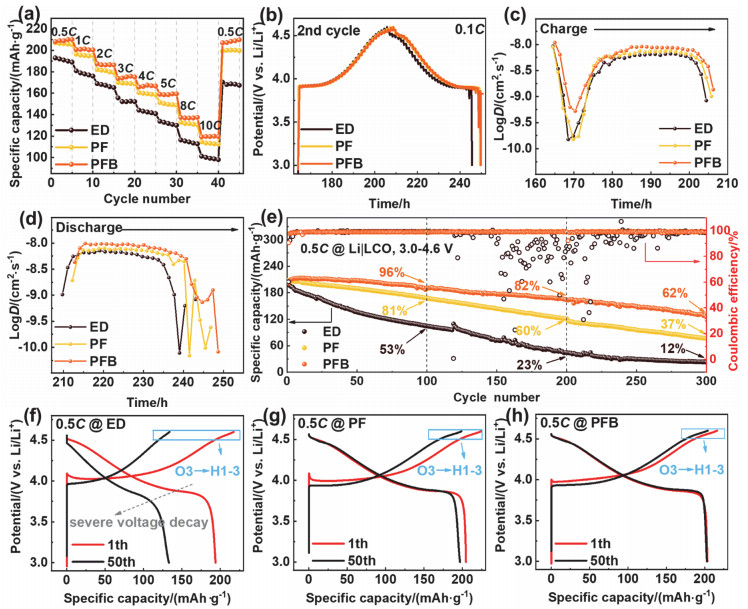
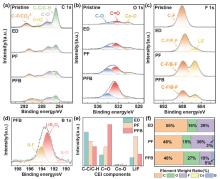
Fig 3
Chemical composition of CEIs on LCO surface cycled in different electrolytes. The typical XPS (a) C 1s, (b) O 1s, (c) F 1s, and (d) B 1s spectra of CEIs derived from ED, PF, and PFB electrolytes. (e) The intensity of CEIs chemical components and (f) the element weight ratio obtained from XPS measurement of CEIs formed in different electrolytes."
Fig 4
(a–c) TEM images of LCO cathodes cycled in (a) ED, (b) PF, and (c) PFB electrolytes at 4.6 V. (d–f) Variation of CEI component ratio with etching time in (d) ED, (e) PF, and (f) PFB electrolytes. (g–i) Contour plots of the (g) O 1s, (h) F 1s, (i) B 1s spectra for the CEI derived from PFB electrolyte."
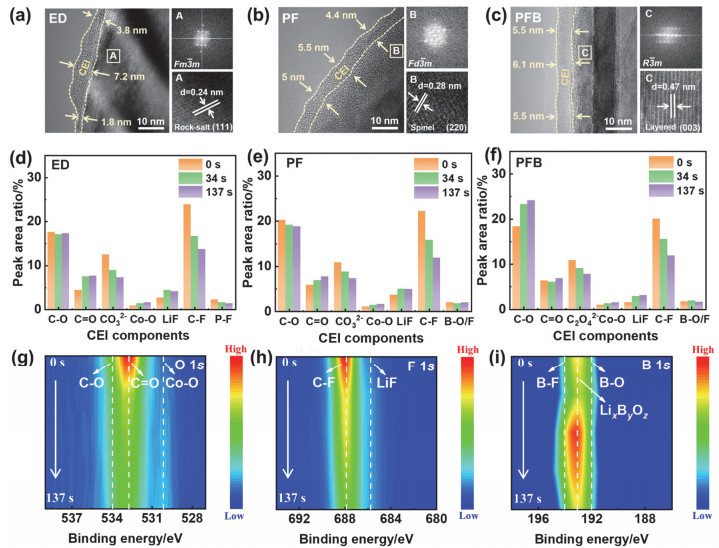
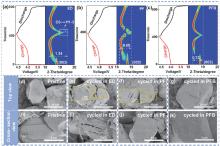
Fig 5
Structural characterizations of the cycled LCO cathodes in different electrolytes at 4.6 V. (a–c) In situ XRD characterization for LCO cathodes cycled in different electrolytes. The voltage profile and corresponding contour plot of the (003) peaks evolution in (a) ED, (b) PF, and (c) PFB electrolytes during the first charge-discharge process (the amplitudes of the peak shifts are marked by the arrows and the O3 to H1-3 phase transition is highlighted in the white rectangle). (d–g) Top view and (h–k) cross-section view SEM images of (d, h) pristine LCO cathode and LCO cathodes cycled in (e, i) ED, (f, j) PF, and (g, k) PFB electrolytes for 100 cycles in the voltage range of 3.0–4.6 V, the cracks are highlighted in the yellow rectangles."
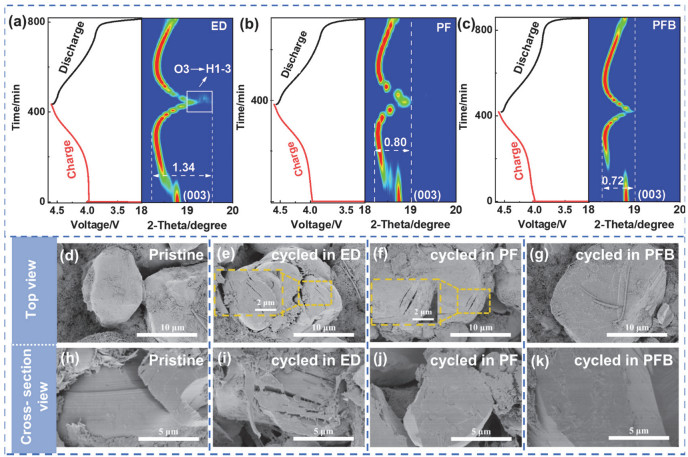
Fig 6
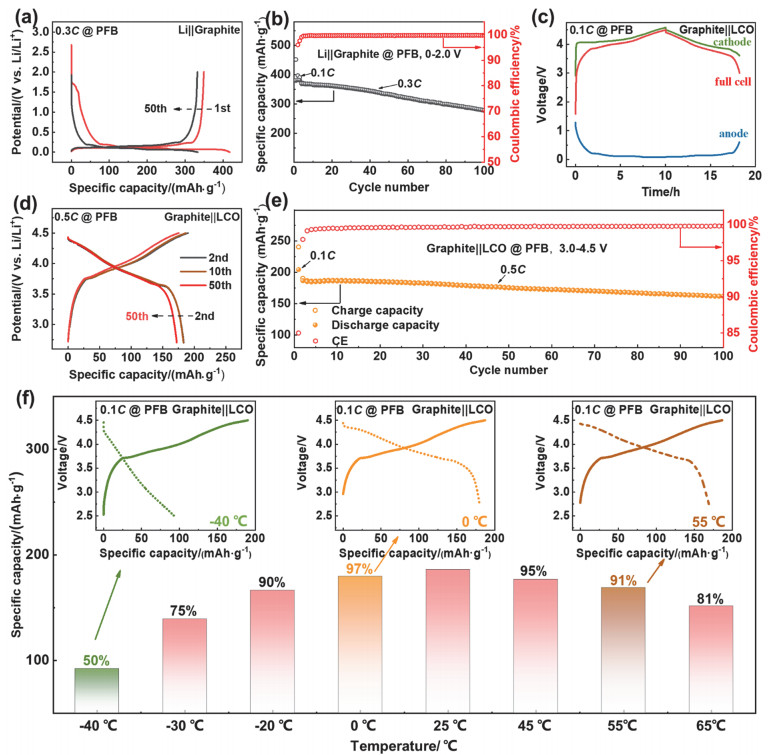
Electrochemical performance of Graphite||LCO full cells. (a) Galvanostatic charge-discharge profiles for the 1st cycle and 50th cycle and (b) cycling performance of graphite anode with PFB electrolyte at 0.3C. (c) Electrode potential and cell voltage of Graphite||LCO full cells with PFB electrolyte during charge and discharge process at 0.1C within the voltage range of 3–4.5 V. (d) The galvanostatic charge-discharge curves for the 1st cycle and the 50th cycle and (e) cycling performance of Graphite||LCO full cells in PFB electrolyte at 0.5C within the voltage range of 3.0–4.5 V. (f) Capacity retention of Graphite||LCO full cells at varied temperatures compared to room temperature (25 ℃) (the insert is corresponding to the charge and discharge curves at the corresponding temperature)."
| 1 |
doi: 10.1002/adma.201800561 |
| 2 |
doi: 10.1039/C8CS00322J |
| 3 |
doi: 10.1002/aenm.202000982 |
| 4 |
doi: 10.1002/adma.202307404 |
| 5 |
doi: 10.1016/j.jpowsour.2022.231873 |
| 6 |
doi: 10.1016/j.electacta.2011.03.070 |
| 7 |
doi: 10.1002/aenm.202303498 |
| 8 |
doi: 10.1016/j.jechem.2022.07.007 |
| 9 |
doi: 10.1002/aenm.202201549 |
| 10 |
doi: 10.1002/adma.202212059 |
| 11 |
doi: 10.1002/adma.202404188 |
| 12 |
doi: 10.1002/advs.202202627 |
| 13 |
doi: 10.1002/adfm.202001974 |
| 14 |
doi: 10.1002/aenm.202200197 |
| 15 |
doi: 10.1002/adma.202210966 |
| 16 |
doi: 10.1002/aenm.202103033 |
| 17 |
doi: 10.1038/s41467-023-36853-x |
| 18 |
doi: 10.1016/j.nanoen.2022.107082 |
| 19 |
doi: 10.1038/s41467-023-38229-7 |
| 20 |
doi: 10.1002/aenm.202300084 |
| 21 |
doi: 10.1016/j.ensm.2022.09.032 |
| 22 |
doi: 10.1021/acsenergylett.3c01954 |
| 23 |
doi: 10.1021/acsenergylett.3c02534 |
| 24 |
doi: 10.1007/s40820-022-00917-2 |
| 25 |
doi: 10.1021/acsenergylett.3c01529 |
| 26 |
doi: 10.1021/acsenergylett.3c00324 |
| 27 |
doi: 10.1038/s41560-019-0336-z |
| 28 |
doi: 10.1002/aenm.201901152 |
| 29 |
doi: 10.1002/aenm.202103806 |
| 30 |
doi: 10.1002/aenm.202201801 |
| 31 |
doi: 10.1002/aenm.202003905 |
| 32 |
doi: 10.1021/acsnano.3c04790 |
| 33 |
doi: 10.1039/D1CS00450F |
| 34 |
doi: 10.1038/s41467-023-36647-1 |
| 35 |
doi: 10.1002/anie.202004853 |
| 36 |
doi: 10.1002/anie.202315608 |
| 37 |
doi: 10.1002/aenm.202401097 |
| 38 |
doi: 10.1021/acsenergylett.2c01722 |
| 39 |
doi: 10.1002/aenm.202200337 |
| 40 |
doi: 10.1038/s41586-022-05627-8 |
| 41 |
doi: 10.1002/anie.202202731 |
| 42 |
doi: 10.1021/acsami.9b16727 |
| 43 |
doi: 10.1002/aenm.202201631 |
| 44 |
doi: 10.1021/acsenergylett.3c00504 |
| 45 |
doi: 10.1002/adfm.202406357 |
| 46 |
doi: 10.1039/D2CS00873D |
| 47 |
doi: 10.1016/j.jpowsour.2014.07.053 |
| 48 |
doi: 10.1002/aenm.202204272 |
| 49 |
doi: 10.1016/j.ensm.2021.10.031 |
| 50 |
doi: 10.1021/acsenergylett.2c02351 |
| 51 |
doi: 10.1002/adma.202206009 |
| 52 |
doi: 10.1002/adfm.202307180 |
| 53 |
doi: 10.1002/anie.202300057 |
| 54 |
doi: 10.1002/adma.202108353 |
| [1] | Aoyu Huang, Jun Xu, Yu Huang, Gui Chu, Mao Wang, Lili Wang, Yongqi Sun, Zhen Jiang, Xiaobo Zhu. Tailoring Electrode-Electrolyte Interfaces via a Simple Slurry Additive for Stable High-Voltage Lithium-Ion Batteries [J]. Acta Phys. -Chim. Sin., 2025, 41(4): 100037-. |
| [2] | Jiandong Liu, Zhijia Zhang, Kamenskii Mikhail, Volkov Filipp, Eliseeva Svetlana, Jianmin Ma. Research Progress on Cathode Electrolyte Interphase in High-Voltage Lithium Batteries [J]. Acta Phys. -Chim. Sin., 2025, 41(2): 100011-. |
| [3] | Zhuo Han, Danfeng Zhang, Haixian Wang, Guorui Zheng, Ming Liu, Yanbing He. Research Progress and Prospect on Electrolyte Additives for Interface Reconstruction of Long-Life Ni-Rich Lithium Batteries [J]. Acta Phys. -Chim. Sin., 2024, 40(9): 2307034-. |
| [4] | Hao Chen, Dongyue Yang, Gang Huang, Xinbo Zhang. Progress on Liquid Organic Electrolytes of Li-O2 Batteries [J]. Acta Phys. -Chim. Sin., 2024, 40(7): 2305059-. |
| [5] | Jiandong Liu, Xin Li, Daxiong Wu, Huaping Wang, Junda Huang, Jianmin Ma. Anion-Acceptor Electrolyte Additive Strategy for Optimizing Electrolyte Solvation Characteristics and Electrode Electrolyte Interphases for Li||NCM811 Battery [J]. Acta Phys. -Chim. Sin., 2024, 40(6): 2306039-. |
| [6] | Qu Zhuoyan, Zhang Xiaoyin, Xiao Ru, Sun Zhenhua, Li Feng. Application of Organosulfur Compounds in Lithium-Sulfur Batteries [J]. Acta Phys. -Chim. Sin., 2023, 39(8): 2301019-0. |
| [7] | Huan Liu, Yu Ma, Bin Cao, Qizhen Zhu, Bin Xu. Recent Progress of MXenes in Aqueous Zinc-Ion Batteries [J]. Acta Phys. -Chim. Sin., 2023, 39(5): 2210027-0. |
| [8] | Mingli Xu, Mengchuang Liu, Zezhou Yang, Chen Wu, Jiangfeng Qian. Research Progress on Presodiation Strategies for High Energy Sodium-Ion Batteries [J]. Acta Phys. -Chim. Sin., 2023, 39(3): 2210043-0. |
| [9] | Tao Zhang, Simin Gong, Ping Chen, Qi Chen, Liwei Chen. Incorporation of a Polyfluorinated Acrylate Additive for High-Performance Quasi-2D Perovskite Light-Emitting Diodes [J]. Acta Phys. -Chim. Sin., 2023, 39(12): 2301024-. |
| [10] | Yuanhao Shen, Qingyu Wang, Jie Liu, Cheng Zhong, Wenbin Hu. Spontaneous Reduction and Adsorption of K3[Fe(CN)6] on Zn Anodes in Alkaline Electrolytes: Enabling a Long-Life Zn-Ni Battery [J]. Acta Phys. -Chim. Sin., 2022, 38(11): 2204048-0. |
| [11] | Peiliang Lü, Caiyun Gao, Xiuhong Sun, Mingliang Sun, Zhipeng Shao, Shuping Pang. Synthesis of Cs-Rich CH(NH2)2)xCs1−xPbI3 Perovskite Films Using Additives with Low Sublimation Temperature [J]. Acta Phys. -Chim. Sin., 2021, 37(4): 2009036-. |
| [12] | Zhida Wang, Yuancheng Feng, Songtao Lu, Rui Wang, Wei Qin, Xiaohong Wu. Improvement in Performance of Three-Dimensional SnLi/Carbon Paper Anode in Lean Electrolyte with In Situ Fluorinated Protection Layer [J]. Acta Phys. -Chim. Sin., 2021, 37(2): 2008082-. |
| [13] | Fanfan Liu, Zhiwen Zhang, Shufen Ye, Yu Yao, Yan Yu. Challenges and Improvement Strategies Progress of Lithium Metal Anode [J]. Acta Phys. -Chim. Sin., 2021, 37(1): 2006021-. |
| [14] | Qin Ran, Tianyang Sun, Chongyu Han, Haonan Zhang, Jian Yan, Jinglun Wang. Natural Polyphenol Tannic Acid as an Efficient Electrolyte Additive for High Performance Lithium Metal Anode [J]. Acta Physico-Chimica Sinica, 2020, 36(11): 1912068-. |
| [15] | Zhenjie CHENG, Yayun MAO, Qingyu DONG, Feng JIN, Yanbin SHEN, Liwei CHEN. Fluoroethylene Carbonate as an Additive for Sodium-Ion Batteries: Effect on the Sodium Cathode [J]. Acta Physico-Chimica Sinica, 2019, 35(8): 868-875. |
|
||