Acta Phys. -Chim. Sin. ›› 2024, Vol. 40 ›› Issue (10): 2310034.doi: 10.3866/PKU.WHXB202310034
• REVIEW • Previous Articles Next Articles
Addressing Challenges and Enhancing Performance of Manganese-based Cathode Materials in Aqueous Zinc-Ion Batteries
Doudou Qin1,2, Junyang Ding1, Chu Liang3,4,*( ), Qian Liu5, Ligang Feng6, Yang Luo7,*(), Guangzhi Hu8, Jun Luo9, Xijun Liu1,2,*()
- 1 State Key Laboratory of Featured Metal Materials and Life-cycle Safety for Composite Structures, Guangxi Key Laboratory of Processing for Non-ferrous Metals and Featured Materials, MOE Key Laboratory of New Processing Technology for Nonferrous Metals and Materials, School of Resources, Environment and Materials, Guangxi University, Nanning 530004, China
2 Guangxi Key Laboratory of Electrochemical Energy Materials, Guangxi University, Nanning 530004, China
3 Zhejiang Carbon Neutral Innovation Institute & Zhejiang International Cooperation Base for Science and Technology on Carbon Emission Reduction and Monitoring, Zhejiang University of Technology, Hangzhou 310014, China
4 Moganshan Institute of ZJUT at Deqing, Huzhou 313200, Zhejiang Province, China
5 Institute for Advanced Study, Chengdu University, Chengdu 610106, China
6 School of Chemistry and Chemical Engineering, Yangzhou University, Yangzhou 225002, Jiangsu Province, China
7 Department of Materials, ETH Zürich, Zürich 8093, Switzerland
8 Institute for Ecological Research and Pollution Control of Plateau Lakes, School of Ecology and Environmental Science, Yunnan University, Kunming 650504, China
9 ShenSi Lab, Shenzhen Institute for Advanced Study, University of Electronic Science and Technology of China, Shenzhen 518110, Guangdong Province, China
-
Received:2023-10-24Revised:2023-12-07Accepted:2023-12-08Published:2024-03-13 -
Contact:Email: cliang@zjut.edu.cn (Chu Liang)yang.luo@mat.ethz.ch (Yang Luo)xjliu@tjut.edu.cn (Xijun Liu) -
Supported by:the National Natural Science Foundation of China(22075211); the National Natural Science Foundation of China(52072342); the National Natural Science Foundation of China(51971157); the Shenzhen Science and Technology Program(JCYJ20210324115412035); the Shenzhen Science and Technology Program(JCYJ20210324123202008); the Shenzhen Science and Technology Program(JCYJ20210324122803009); the Shenzhen Science and Technology Program(ZDSYS20210813095534001); the Guangdong Basic and Applied Basic Research Foundation(2021A1515110880); the Tianjin Science Fund for Distinguished Young Scholars(19JCJQJC61800)

Cite this article
Doudou Qin, Junyang Ding, Chu Liang, Qian Liu, Ligang Feng, Yang Luo, Guangzhi Hu, Jun Luo, Xijun Liu. Addressing Challenges and Enhancing Performance of Manganese-based Cathode Materials in Aqueous Zinc-Ion Batteries[J]. Acta Phys. -Chim. Sin. 2024, 40(10), 2310034. doi: 10.3866/PKU.WHXB202310034
share this article
Fig 1
A brief development on Mn-based cathodes of ZIBs, including a few representative studies on reaction principles and improvement measures."
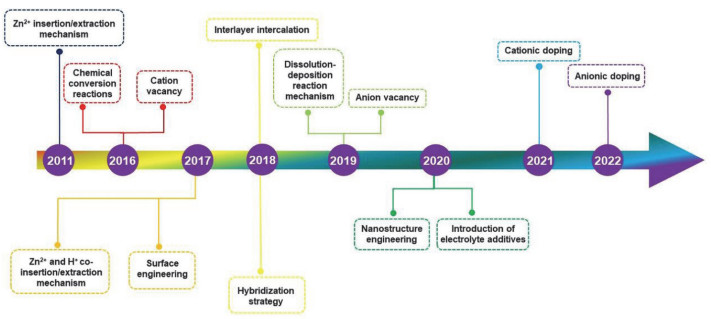
Fig 2
Schematic diagrams of the four Zn2+ ion storing mechanisms for manganese-based cathodes of ZIB: (1) Zn2+ insertion/extraction principle; (2) Zn2+ and H+ co-insertion/extraction principle; (3) dissolution-deposition reaction principle; (4) chemical conversion reactions."
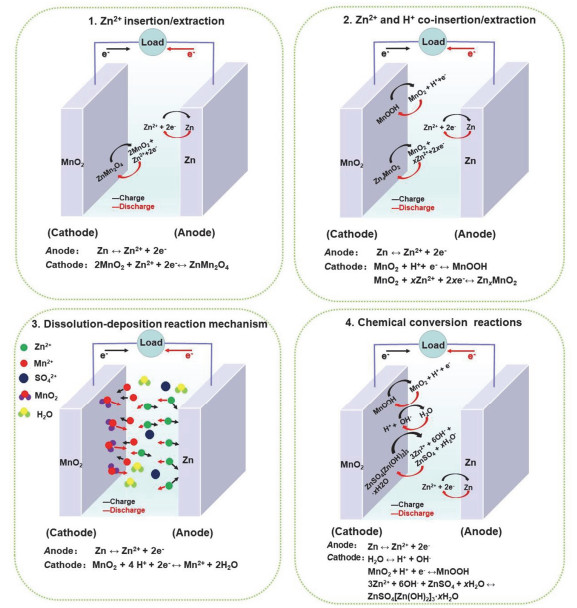
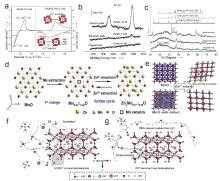
Fig 3
(a) The invertible insertion/detachment process of Zn2+ into the tunnel of α-MnO2 cathode. (b) Zn 2p core level spectra of MnO2 cathodes in the pristine, extraction, and inserted condition. (c) X-ray diffraction (XRD) spectrum of α-MnO2 cathodes in the initial, extracted as well as inserted circumstance. Reprinted by permit from the Ref. 58. (d) Formation of Mn defects and invertible Zn2+ interposition/extraction in a MnO skeleton. (e) Electric charge allocation and structural changes of MnO and Mn0.61□0.39O before and after the bivalent Zn2+ ion insertion. Reprinted by permit from Ref. 59. (f) Schematic diagram of the H+ and Zn2+ co-insertion/detachment principle of the cathode in pure water electrolytic solution. (g) Schematic diagram of hydrophilic polyethylene glycol (PEG) electrolyte changing the solvation environment of electrolyte and forming the proton shielding in H2O-50% PEG system. Reprinted by permit from Ref. 60."
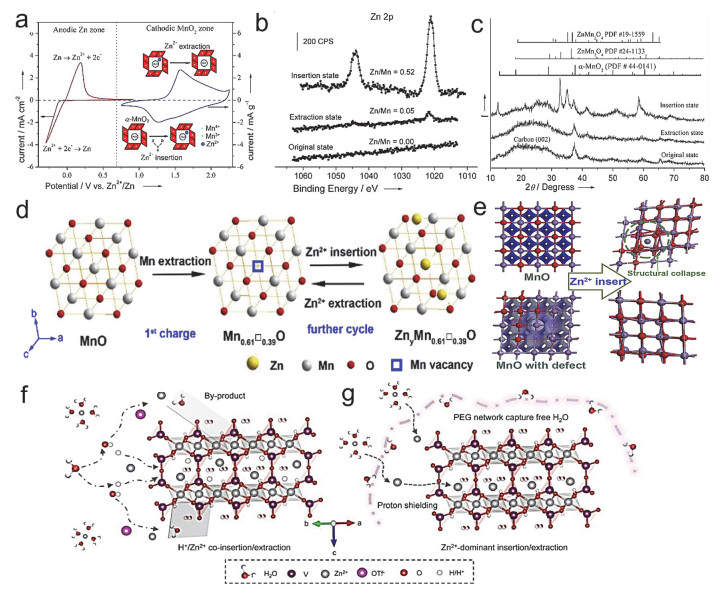
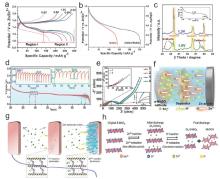
Fig 4
(a) Charge-discharge profiles of Zn/MnO2@carbon fiber paper (CFP) battery at various rates in the first circulation. (b) The discharge curves of the cathode using the three-electrode cell in 0.2 mol∙L−1 MnSO4 electrolytic solution with or without Zn2+ at a rate of 0.3C in the range from 0 to 0.8 V (vs. Ag/AgCl). (c) ex situ XRD measurements of the MnO2@CFP cathode at discharge depths of 1.3 and 1.0 V, respectively, keeping the respective discharge depths for 1 h. Reprinted by permit from Ref. 67. (d) Discharge galvanostatic intermittent titration technique (GITT) measurement of the α-MnBOx cathode (at 50 mA∙g−1 for 120 s followed by a 0.5 h rest). (e) Electrochemical impedance spectroscopy (EIS) spectra of cathodes at four different stages of the discharge (marked by four arrows in (d)). (f) Schematic diagram of the H+/Zn2+ insertion/deintercalation principle occurring at the α-MnBOx cathode. Reprinted by permit from Ref. 69 (g) Mechanistic diagram of H+ and Zn2+ insertion in polyaniline (PANI)-intercalated α-MnO2. Reprinted by permit from Ref. 70. (h) Illustration of the joint charge storing principle consisting of nondiffusion controlled Zn2+ ion storage mechanism and diffusion controlled H+ transformation reaction in layered δ-MnO2. Reprinted by permit from Ref. 71."
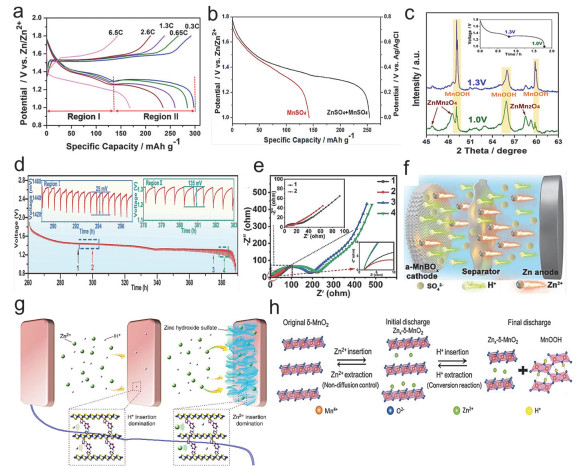
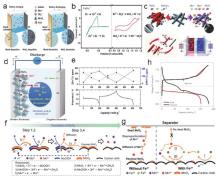
Fig 5
(a) Schematic diagram of the mass transfer process during the charge-discharge course of the battery. (b) The cyclic voltammetry (CV) curves for the single electrode of MnO2–Zn cell. Reprinted by permit from Ref. 78. (c) The formation of a Zn-Mn flow battery. Reprinted by permit from Ref. 79. (d) Reaction principle of α-MnO2/Zn cell on the basis of Mn solubilization/re-combination in discharging process. (e) Variation of the content of Zn (black regular tetragon) and Mn (blue regular tetragon) at the electrolytic solution in the corresponding discharging-charging curve of the α-MnO2/Zn battery. Reprinted by permit from Ref. 80. (f) Illustration of the dissolution process of MnO2 in acidic electrolytes as well as the corresponding reaction. (g) Schematic illustration of the deposition/solubilization chemistry of MnO2 in prototype Cu//MnO2 batteries. Reprinted by permit from Ref. 81. (h) Charge/discharge curves of the rechargeable Zn/MnO2 battery with the mild electrolysing solution of ZnSO4 in the initial two cycles. Reprinted by permit from Ref. 41."
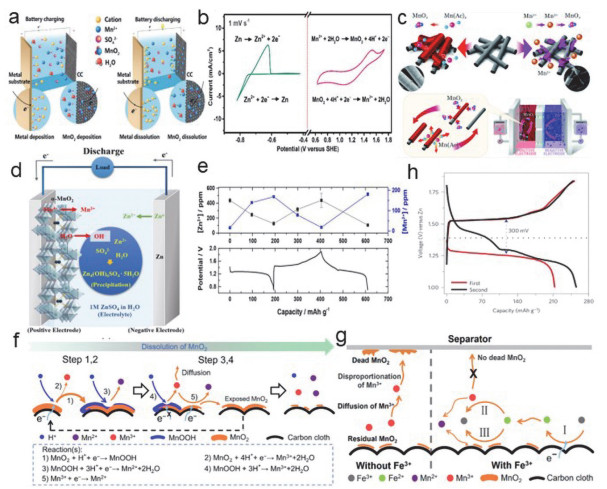
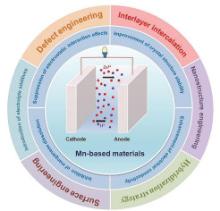
Fig 6
The challenges and optimization strategies to improve the electrochemical properties of Mn-based cathodes in ZIBs."
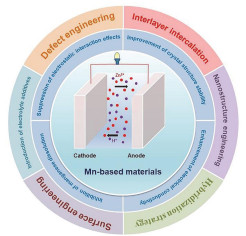
Fig 7
(a) Schematic comparison of the adsorption properties of Zn2+ on the facades of ideal δ-MnO2 (001) and δ-MnO2 (001) including oxygen vacancies. The schematic diagram of Zn2+ absorption/desorption processes for (b) ideal MnO2 and (c) MnO2 including oxygen vacancies. Reprinted by permit from Ref. 103. (d) High-resolution XPS spectra of O. (e) CV profiles of 700-Ar, 700-Air, and Mn-BTC electrodes at 0.1 mV∙s−1. (f) EIS profiles of 700-Ar, 700-Air, and Mn-BTC electrodes. Reprinted by permit from Ref. 104. Scanning electron microscopy (SEM) images of the surface morphology of (g) Bir-MnO2 and (h) Odc-MnO2. Reprinted by permit from Ref. 105. (i) X-ray absorption near-edge structure (XAN22ES) spectra of O 1s. Reprinted by permit from Ref. 100."
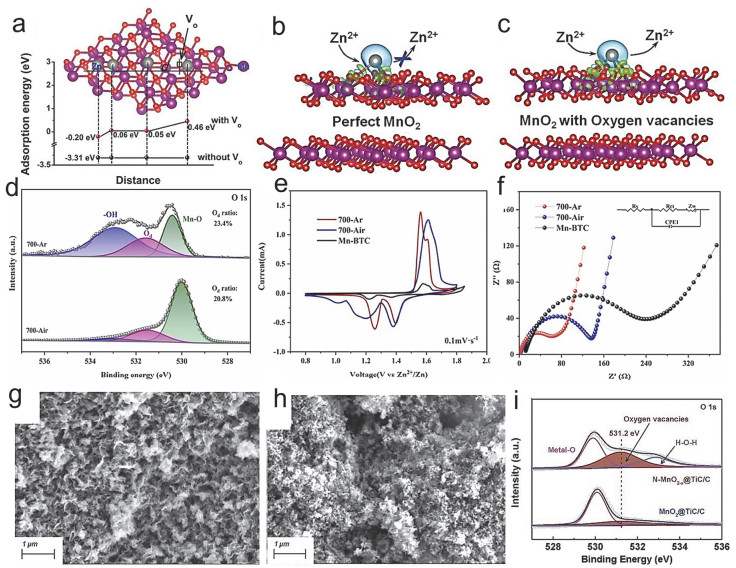
Fig 8
(a) Schematic diagram of the diffusion pathway of Zn2+ in the ideal ZnMn2O4 spinel framework and in ZnMn2O4 containing Mn vacant sites. Reprinted by permit from Ref. 108. (b) XPS spectra of initial and first totally charged statuses. Calculated density of states (DOS) of (c) partial MnO without Mn defect and (d) partial MnO with Mn defects. Reprinted by permit from Ref. 59. (e) Illustration of relative energy profiles along the reaction pathways (steps Ⅰ to Ⅳ). Reprinted by permit from Ref. 75. (f) Atomic configuration of manganese defects Mn3O4 (MO) (101) and six categories of manganese atoms. (g) A schematic diagram of the most possible structures for MO anchored on carbon nanotubes surface (DMO) and the formation of surface active sites. Reprinted by permit from Ref. 109. (h) Rate the performance of different materials at various current densities. Reprinted by permit from Ref. 113."
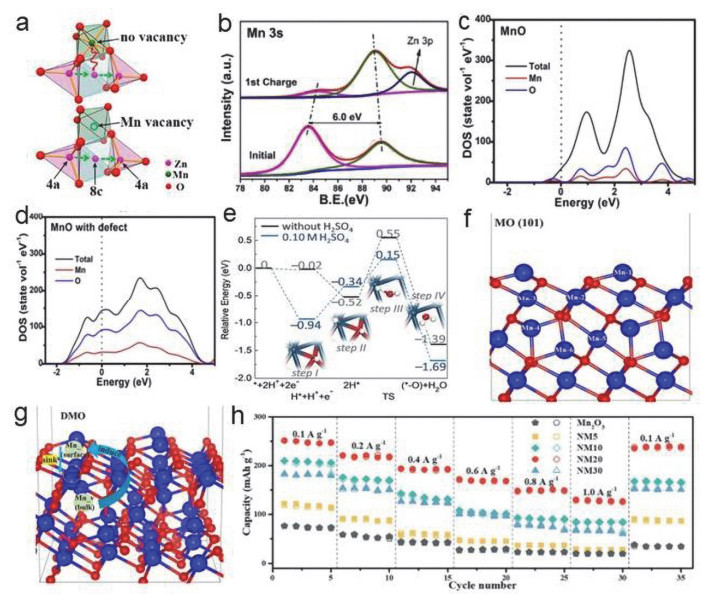
Fig 9
(a) Schematic of charge distribution for Mn2O3 and NM20 (denoting the atomic ratio of Ni and Mn as 1 : 20 of the NiMn-layered double hydroxide). (b) The projected density of states (PDOS) of the Mn2O3 and NM20. Reprinted by permit from Ref. 113. (c) Illustration of the prepared cobalt-modified δ-MnO2. Reprinted by permit from Ref. 117. (d) The crystal construction diagram of HxMn2O4 microspheres. Reprinted by permit from Ref. 120. (e) GITT profiles and the related Zn2+ ion diffusion coefficients in the batteries cycling process for MnO2 and S-MnO2 electrodes. Charge density difference distribution diagrams for Zn ion in (f) MnO2 (g) and S-MnO2. Reprinted by permit from Ref. 122. (h) Schematic demonstration of N-MnO2–x@TiC/C arrays. Density of states (DOS) of (i) initial MnO2 and (j) N-MnO2–x. Reprinted with permission from Ref. 100."
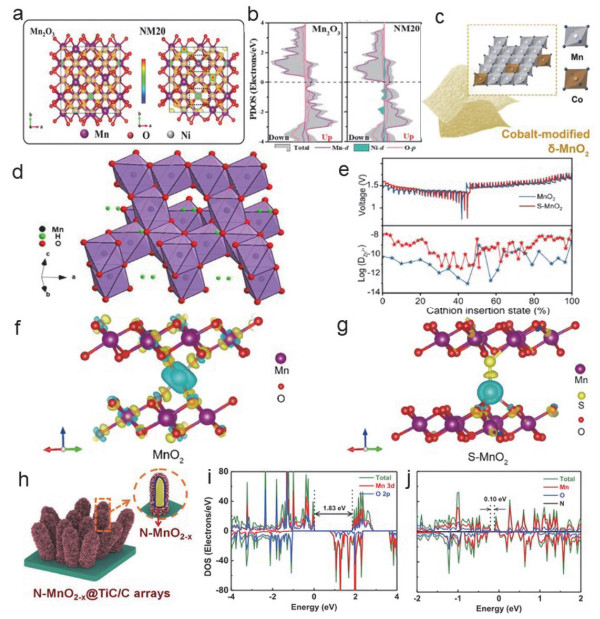
Fig 10
(a) The XRD pattern and (inset) crystalline structure of MnO2 containing crystal water (cw-MnO2). (b) The generation of a zinc-manganese dumbbell-shape construction in cw-MnO2. Reprinted by permit from Ref. 127. (c) The crystalline construction diagram of the as-synthesized Na0.55Mn2O4∙0.57H2O (NMOH). (d) SEM image of NMOH. (e) Galvanostatic charging-discharging curves of the Zn/NMOH battery examined from 0.8 to 1.9 V with various current densities. Reprinted by permit from Ref. 128. (f) Structural display of CaMnO. Reprinted with permission from Ref. 129. (g) Structure diagram of PANI-intercalated MnO2 nanoscale layers. Reprinted by permit from Ref. 70."
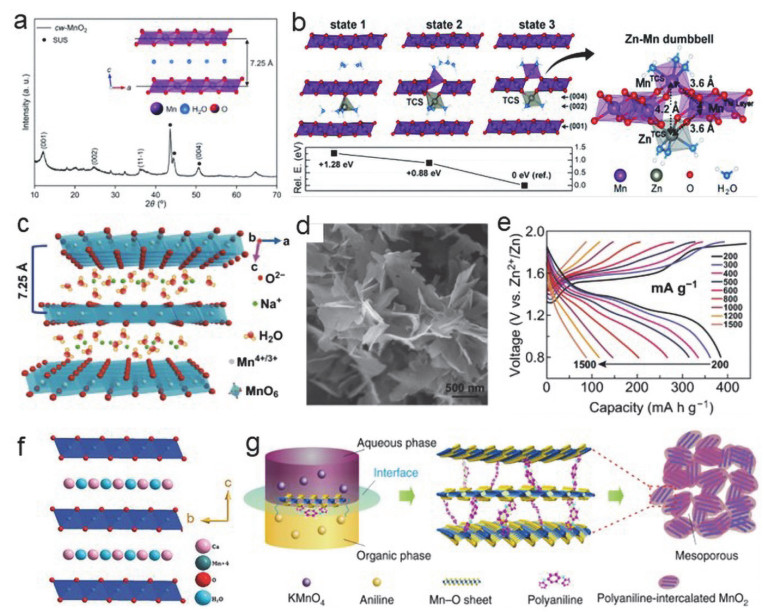
Fig 11
(a) Field-emission scanning electron microscopy (FE-SEM) image of the carbon-coated MnO2. Reprinted by permit from Ref. 141. (b) The high-resolution transmission electron microscope (TEM) (denoted as HRTEM) of α-MnO2/graphene scrolls. Reprinted by permit from Ref. 142. (c) Energy-dispersive X-ray (EDX) elemental mapping images of MnO2/polypyrrole nanorod. (d) The optimized configuration of the unordered MnO2 surface with polypyrrole covering. Reprinted by permit from Ref. 149. (e) Preparation schematic diagram of MnO2/rGO/PANI. Reprinted by permit from Ref. 137. (f) The model diagram of zinc ion insertion into CaSO4·2H2O (CS). (g) A schematic diagram of the possible migration path of Zn2+ in CaSO4∙2H2O. Reprinted by permit from Ref. 153. (h) Comparing of long-term cyclic performance of MnO@C with some former Mn-based cathodes in the Zn-including electrolytic solution without the addition of Mn2+ for ZIBs. Reprinted by permit from Ref. 154."
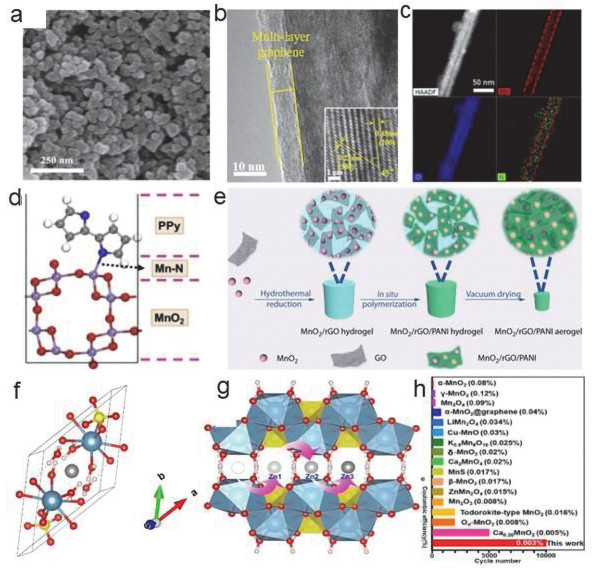
Fig 12
(a) SEM image of Mn3O4 deposited on carbon paper. (b) The cyclic performance diagram of the cell at a current density of 1 A∙g−1. (c) The illustration of the rate capability testing of the battery at diverse current densities. Reprinted by permit from Ref. 166. (d) TEM images of the α-MnO2@CNT foams. (e) Illustration of the preparation of flexible quasi-solid-state ZIBs using α-MnO2@CNTs composite films. Reprinted with permission from Ref. 172. (f) Schematic representation illustrating electron/ion transport of the heterofibrous network scaffold (HNS) electrode. (g) Contrast of the MnO2-based gravimetric energy/power densities (represented as Wh∙kg−1/W∙kg−1): HNS electrode vs. formerly investigated MnO2 electrodes. Reprinted by permit from Ref. 173."
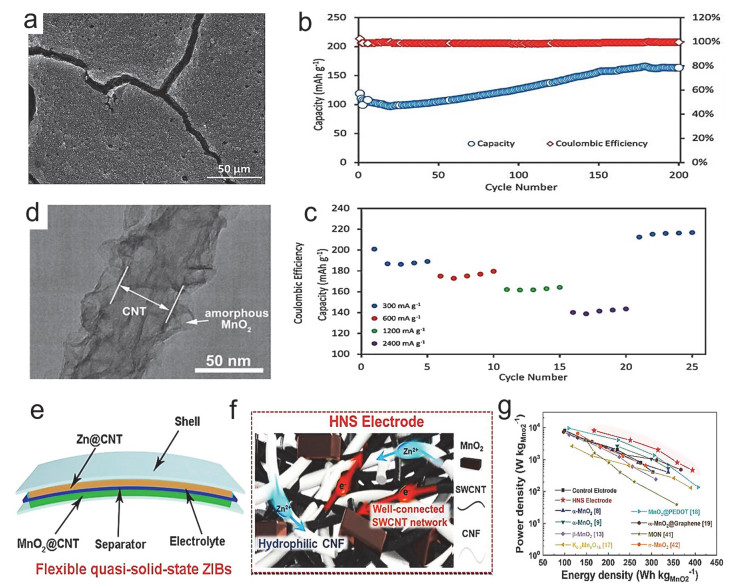
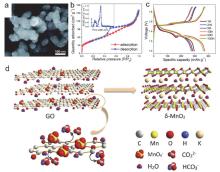
Fig 13
(a) SEM image of the as-prepared MnO2 samples. (b) N2 adsorption/desorption isotherms and related pore size distributions of prepared MnO2 samples (inset). (c) Profiles of charging/discharging at a current density of 0.3 A∙g−1. Reprinted by permit from Ref. 184. (d) Schematic illustration of ultrathin layered 2D δ-MnO2 nanosheet formation. Reprinted by permit from Ref. 185."
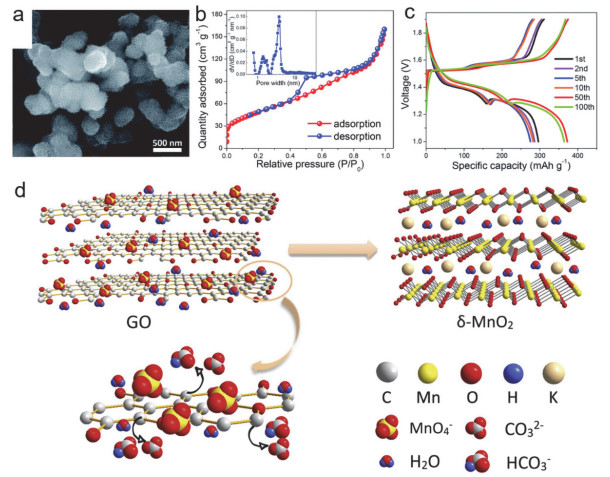
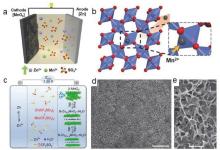
Fig 14
(a) The schematic diagram of ZIB assembled with MnSO4 additive in ZnSO4 electrolyte. (b) The illustration of the enhanced structural stability of MnO2 cathode due to the presence of Mn2+ additive in the electrolyte. Reprinted by permit from Ref. 194. (c) A schematic diagram of the use of 0.1 mol∙L−1 Mn(CF3SO3)2 additive in ZIB. (d) Low magnification SEM image of MnO2 cathode with a scale bar of 5 μm. (e) High magnification SEM image of MnO2 cathode with a scale bar of 1 μm. Reprinted by permit from Ref. 195."
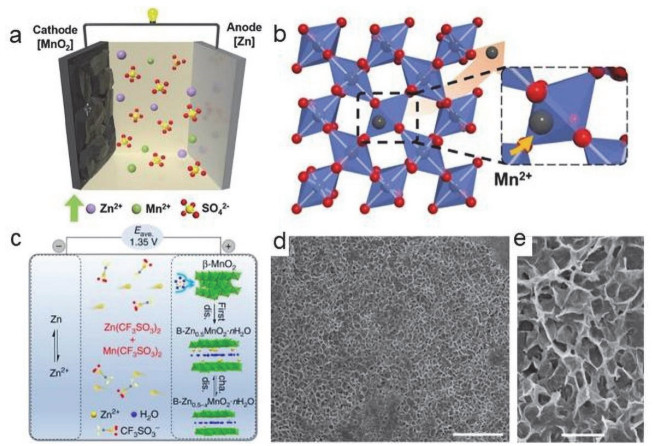
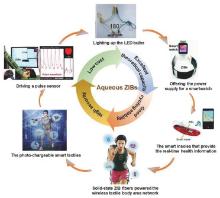
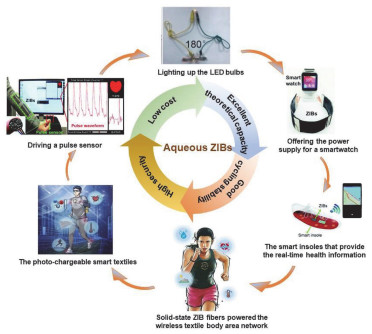
Fig 15
Schematic diagram of the practical application of excellent-performance ZIBs based on the Mn-based cathode materials. Reproduced by permit from Ref. 174,207-209."
| 1 |
doi: 10.1038/s41560-022-01100-y |
| 2 |
doi: 10.1016/j.jcis.2022.12.067 |
| 3 |
doi: 10.1007/s40843-022-2379-8 |
| 4 |
doi: 10.1007/s11356-020-09238-6 |
| 5 |
doi: 10.1016/j.rser.2017.05.055 |
| 6 |
doi: 10.1002/sstr.202200086 |
| 7 |
doi: 10.1016/j.enpol.2016.11.035 |
| 8 |
doi: 10.1016/j.esr.2019.01.006 |
| 9 |
doi: 10.1002/smll.202204524 |
| 10 |
doi: 10.1038/s41560-017-0036-5 |
| 11 |
doi: 10.1007/s12274-022-4929-7 |
| 12 |
doi: 10.1039/D2CC05722K |
| 13 |
doi: 10.1016/j.rser.2013.12.037 |
| 14 |
doi: 10.1016/j.rser.2019.01.023 |
| 15 |
doi: 10.1039/D2CC04591E |
| 16 |
doi: 10.1002/tcr.201700057 |
| 17 |
doi: 10.1016/j.jpowsour.2021.230800 |
| 18 |
doi: 10.1039/C7JA00073A |
| 19 |
doi: 10.1016/j.inoche.2022.110170 |
| 20 |
doi: 10.1016/j.est.2021.103623 |
| 21 |
doi: 10.1002/adfm.202004410 |
| 22 |
doi: 10.1002/er.3480 |
| 23 |
doi: 10.1039/C4EE03192J |
| 24 |
doi: 10.1016/j.elecom.2015.09.002 |
| 25 |
doi: 10.1038/srep32330 |
| 26 |
doi: 10.1039/C7TA04515H |
| 27 |
doi: 10.1021/acsenergylett.8b01426 |
| 28 |
doi: 10.1039/d2cc01798a |
| 29 |
doi: 10.1002/smll.202107662 |
| 30 |
doi: 10.1021/acsami.1c23278 |
| 31 |
doi: 10.1021/acs.jpcc.3c00810 |
| 32 |
doi: 10.1039/d2sc04945g |
| 33 |
doi: 10.1039/c7ta07170a |
| 34 |
doi: 10.1002/tcr.202200088 |
| 35 |
doi: 10.1039/C8CC07730D |
| 36 |
doi: 10.26599/NRE.2023.9120039 |
| 37 |
doi: 10.1039/d1ee01851e |
| 38 |
doi: 10.1002/anie.202301192 |
| 39 |
doi: 10.1002/adfm.202213882 |
| 40 |
doi: 10.1039/c8cc02250j |
| 41 |
doi: 10.1038/nenergy.2016.39 |
| 42 |
doi: 10.1016/j.jallcom.2022.167933 |
| 43 |
doi: 10.1021/acsami.1c21581 |
| 44 |
doi: 10.1002/adma.201901521 |
| 45 |
doi: 10.1002/aenm.201400930 |
| 46 |
doi: 10.1016/j.jechem.2020.06.013 |
| 47 |
doi: 10.1016/j.electacta.2017.10.166 |
| 48 |
doi: 10.1016/j.jpowsour.2015.04.140 |
| 49 |
doi: 10.1039/D0TA09212F |
| 50 |
doi: 10.1016/j.jpowsour.2022.232353 |
| 51 |
doi: 10.1002/advs.202002636 |
| 52 |
doi: 10.1007/s40843-020-1503-7 |
| 53 |
doi: 10.1002/admi.201900387 |
| 54 |
doi: 10.1002/smll.201804760 |
| 55 |
doi: 10.1039/C4CP03888F |
| 56 |
doi: 10.1002/adfm.201802564 |
| 57 |
doi: 10.1002/cssc.202002493 |
| 58 |
doi: 10.1002/anie.201106307 |
| 59 |
doi: 10.1016/j.ensm.2019.07.030 |
| 60 |
doi: 10.1016/j.ensm.2023.01.049 |
| 61 |
doi: 10.1016/j.cej.2022.141162 |
| 62 |
doi: 10.1016/j.elecom.2017.02.012 |
| 63 |
doi: 10.1002/aenm.202000081 |
| 64 |
doi: 10.1002/aenm.201601920 |
| 65 |
doi: 10.1039/D0TA01297A |
| 66 |
doi: 10.1021/acsami.9b12128 |
| 67 |
doi: 10.1021/jacs.7b04471 |
| 68 |
doi: 10.1039/C4CS00218K |
| 69 |
doi: 10.1002/advs.202205794 |
| 70 |
doi: 10.1038/s41467-018-04949-4 |
| 71 |
doi: 10.1002/adma.201900567 |
| 72 |
doi: 10.1039/C5CC02585K |
| 73 |
doi: 10.1021/cm504717p |
| 74 |
doi: 10.1039/C8TA01031E |
| 75 |
doi: 10.1002/anie.201904174 |
| 76 |
doi: 10.1002/smll.202207249 |
| 77 |
doi: 10.1002/aenm.201902085 |
| 78 |
doi: 10.1002/aenm.201901838 |
| 79 |
doi: 10.1039/c9ee03702k |
| 80 |
doi: 10.1002/cssc.201600702 |
| 81 |
doi: 10.1039/d3ee00018d |
| 82 |
doi: 10.1002/adma.202109092 |
| 83 |
doi: 10.1002/adma.202001113 |
| 84 |
doi: 10.1016/j.jechem.2020.07.027 |
| 85 |
doi: 10.1039/C8EE01415A |
| 86 |
doi: 10.1021/acsenergylett.3c01821 |
| 87 |
doi: 10.1002/adma.202300053 |
| 88 |
doi: 10.1038/srep06066 |
| 89 |
doi: 10.1016/j.jcis.2023.02.026 |
| 90 |
doi: 10.1016/j.electacta.2018.04.139 |
| 91 |
doi: 10.1039/C9CS00131J |
| 92 |
doi: 10.1016/j.inoche.2023.110621 |
| 93 |
doi: 10.1002/aenm.201800589 |
| 94 |
doi: 10.1021/acsenergylett.9b00247 |
| 95 |
doi: 10.1021/cr3004949 |
| 96 |
doi: 10.1016/j.mattod.2019.05.021 |
| 97 |
doi: 10.1002/adma.201804672 |
| 98 |
doi: 10.1039/D3QI00013C |
| 99 |
doi: 10.1002/adfm.201400474 |
| 100 |
doi: 10.1002/smll.201905452 |
| 101 |
doi: 10.1002/aenm.201700005 |
| 102 |
doi: 10.1038/nmat4810 |
| 103 |
doi: 10.1002/aenm.201803815 |
| 104 |
doi: 10.1016/j.jallcom.2022.166470 |
| 105 |
doi: 10.1002/cnma.202000300 |
| 106 |
doi: 10.1039/D3TA05364D |
| 107 |
doi: 10.1016/j.jechem.2023.08.022 |
| 108 |
doi: 10.1021/jacs.6b05958 |
| 109 |
doi: 10.1016/j.jechem.2021.12.033 |
| 110 |
doi: 10.1039/C9TA05101E |
| 111 |
doi: 10.1039/C9TA08049J |
| 112 |
doi: 10.1021/acsaem.0c00357 |
| 113 |
doi: 10.1002/adfm.202009412 |
| 114 |
doi: 10.1021/acsami.1c17677 |
| 115 |
doi: 10.1039/C9TA08418E |
| 116 |
doi: 10.1021/acs.jpcc.9b05535 |
| 117 |
doi: 10.1016/j.isci.2020.100943 |
| 118 |
doi: 10.1016/j.electacta.2019.135296 |
| 119 |
doi: 10.1016/j.apsusc.2017.02.009 |
| 120 |
doi: 10.1021/acsaem.9b01554 |
| 121 |
doi: 10.1021/acs.cgd.3c00864 |
| 122 |
doi: 10.1016/j.ensm.2022.02.030 |
| 123 |
doi: 10.1002/advs.202000083 |
| 124 |
doi: 10.1021/acsenergylett.8b01423 |
| 125 |
doi: 10.1002/aenm.201901968 |
| 126 |
doi: 10.1002/anie.202215654 |
| 127 |
doi: 10.1039/c9ee00718k |
| 128 |
doi: 10.1007/s40820-020-0397-3 |
| 129 |
doi: 10.1002/smll.202000597 |
| 130 |
doi: 10.1002/aenm.201900083 |
| 131 |
doi: 10.1039/D0QM00051E |
| 132 |
doi: 10.1002/adma.201703725 |
| 133 |
doi: 10.1002/anie.201713291 |
| 134 |
doi: 10.1039/C8EE01651H |
| 135 |
doi: 10.1016/j.chempr.2020.02.001 |
| 136 |
doi: 10.1016/j.nanoen.2019.04.038 |
| 137 |
doi: 10.1007/s10118-020-2353-6 |
| 138 |
doi: 10.1016/j.jcis.2021.04.057 |
| 139 |
doi: 10.1002/admi.201801506 |
| 140 |
doi: 10.1016/j.apsusc.2021.149041 |
| 141 |
doi: 10.1016/j.jechem.2017.04.002 |
| 142 |
doi: 10.1002/smll.201703850 |
| 143 |
doi: 10.1016/j.cej.2020.125509 |
| 144 |
doi: 10.1021/acsnano.8b02744 |
| 145 |
doi: 10.1016/j.jcis.2022.11.153 |
| 146 |
doi: 10.1002/adfm.202103070 |
| 147 |
doi: 10.1002/anie.201609527 |
| 148 |
doi: 10.1002/celc.202000253 |
| 149 |
doi: 10.1016/j.mtener.2020.100475 |
| 150 |
doi: 10.1002/adma.201700274 |
| 151 |
doi: 10.1021/jacs.7b10688 |
| 152 |
doi: 10.1021/acsenergylett.9b02029 |
| 153 |
doi: 10.1021/acsnano.9b07042 |
| 154 |
doi: 10.1016/j.cej.2021.132673 |
| 155 |
doi: 10.1016/j.jallcom.2023.169271 |
| 156 |
doi: 10.26599/NRE.2023.9120049 |
| 157 |
doi: 10.1039/C3NR06361E |
| 158 |
doi: 10.1021/acsami.9b22470 |
| 159 |
doi: 10.1038/s41598-019-44915-8 |
| 160 |
doi: 10.1039/D2TA02734H |
| 161 |
doi: 10.1016/j.jcis.2021.11.137 |
| 162 |
doi: 10.1002/er.7841 |
| 163 |
doi: 10.1002/adma.201603812 |
| 164 |
doi: 10.1039/C8TA01198B |
| 165 |
doi: 10.1002/celc.202200750 |
| 166 |
doi: 10.1002/batt.201900150 |
| 167 |
doi: 10.1016/j.cej.2017.03.076 |
| 168 |
doi: 10.1016/j.jcis.2021.11.064 |
| 169 |
doi: 10.1039/c7ta00100b |
| 170 |
doi: 10.1039/C8TA02747A |
| 171 |
doi: 10.1021/acs.chemmater.8b05093 |
| 172 |
doi: 10.1016/j.mtener.2020.100548 |
| 173 |
doi: 10.1002/smll.202002837 |
| 174 |
doi: 10.1002/cssc.201903006 |
| 175 |
doi: 10.1002/adfm.201907120 |
| 176 |
doi: 10.1038/s41467-020-16039-5 |
| 177 |
doi: 10.1007/s12274-017-1448-z |
| 178 |
doi: 10.1002/aenm.201600655 |
| 179 |
doi: 10.1039/D2DT00047D |
| 180 |
doi: 10.1039/C8TA02018C |
| 181 |
doi: 10.1016/j.mtener.2020.100431 |
| 182 |
doi: 10.1039/c6cc05252e |
| 183 |
doi: 10.1039/d1ta05982c |
| 184 |
doi: 10.1039/C9TA03541A |
| 185 |
doi: 10.1016/j.electacta.2019.03.008 |
| 186 |
doi: 10.3390/nano8050301 |
| 187 |
doi: 10.1039/c6ta10345f |
| 188 |
doi: 10.1016/j.electacta.2021.138447 |
| 189 |
doi: 10.1007/s40843-020-1293-8 |
| 190 |
doi: 10.1021/acsaem.1c00573 |
| 191 |
doi: 10.1039/d2ee04023a |
| 192 |
doi: 10.1038/s41467-018-04060-8 |
| 193 |
doi: 10.1016/j.ensm.2019.12.021 |
| 194 |
doi: 10.1002/er.7687 |
| 195 |
doi: 10.1038/s41467-017-00467-x |
| 196 |
doi: 10.1002/adma.202203249 |
| 197 |
doi: 10.1016/j.esci.2021.11.002 |
| 198 |
doi: 10.1039/c8ee01991f |
| 199 |
doi: 10.1002/celc.202101724 |
| 200 |
doi: 10.1016/j.cej.2023.142105 |
| 201 |
doi: 10.1002/adma.202208237 |
| 202 |
doi: 10.1002/smll.202104965 |
| 203 |
doi: 10.1007/s12274-022-4477-1 |
| 204 |
doi: 10.1007/s12274-018-2172-z |
| 205 |
doi: 10.1002/aenm.202203540 |
| 206 |
doi: 10.1002/anie.202300608 |
| 207 |
doi: 10.1016/j.matt.2020.01.022 |
| 208 |
doi: 10.1039/C7EE03232C |
| 209 |
doi: 10.1126/sciadv.abl3742 |
| 210 |
doi: 10.1002/eom2.12409 |
| 211 |
doi: 10.1021/acssuschemeng.3c02379 |
| 212 |
doi: 10.1093/nsr/nwad265 |
| 213 |
doi: 10.1002/adma.202210789 |
| 214 |
doi: 10.1016/j.apmate.2022.100062 |
| 215 |
doi: 10.1016/j.ensm.2022.10.027 |
| 216 |
doi: 10.1016/j.apcatb.2023.122488 |
| 217 |
doi: 10.1021/acsami.2c21616 |
| 218 |
doi: 10.1016/j.cej.2021.132990 |
| 219 |
doi: 10.1016/j.ensm.2022.10.046 |
| 220 |
doi: 10.3866/PKU.WHXB202006059 |
|
沈晓帆; 王晓娜; 俞能晟; 杨薇; 周雨融; 石艳红; 王玉莲; 董立忠; 邸江涛; 李清文. 物理化学学报, 2022, 38, 2006059.
doi: 10.3866/PKU.WHXB202006059 |
|
| 221 |
doi: 10.3866/PKU.WHXB202210014 |
|
吕浩亮; 王雪杰; 杨宇; 刘涛; 张留洋. 物理化学学报, 2023, 39, 2210014.
doi: 10.3866/PKU.WHXB202210014 |
|
| 222 |
doi: 10.3866/PKU.WHXB202210043 |
|
徐铭礼; 刘猛闯; 杨泽洲; 吴晨; 钱江锋. 物理化学学报, 2022, 39, 2210043.
doi: 10.3866/PKU.WHXB202210043 |
|
| 223 |
doi: 10.1016/j.jcis.2023.10.157 |
| 224 |
doi: 10.20517/cs.2023.28 |
| 225 |
doi: 10.1016/j.jcis.2023.11.069 |
| 226 |
doi: 10.1002/cey2.217 |
| [1] | Liangliang Song, Haoyan Liang, Shunqing Li, Bao Qiu, Zhaoping Liu. Challenges and strategies on high-manganese Li-rich layered oxide cathodes for ultrahigh-energy-density batteries [J]. Acta Phys. -Chim. Sin., 2025, 41(8): 100085-. |
| [2] | Xueyu Lin, Ruiqi Wang, Wujie Dong, Fuqiang Huang. Rational Design of Bimetallic Oxide Anodes for Superior Li+ Storage [J]. Acta Phys. -Chim. Sin., 2025, 41(3): 100021-. |
| [3] | Yu Guo, Zhiwei Huang, Yuqing Hu, Junzhe Li, Jie Xu. Recent Advances in Iron-based Heterostructure Anode Materials for Sodium Ion Batteries [J]. Acta Phys. -Chim. Sin., 2025, 41(3): 100022-. |
| [4] | Zhuo Wang, Xue Bai, Kexin Zhang, Hongzhi Wang, Jiabao Dong, Yuan Gao, Bin Zhao. MOF-Templated Synthesis of Nitrogen-Doped Carbon for Enhanced Electrochemical Sodium Ion Storage and Removal [J]. Acta Phys. -Chim. Sin., 2025, 41(3): 100026-. |
| [5] | Shanghua Li, Malin Li, Xiwen Chi, Xin Yin, Zhaodi Luo, Jihong Yu. High-Stable Aqueous Zinc Metal Anodes Enabled by an Oriented ZnQ Zeolite Protective Layer with Facile Ion Migration Kinetics [J]. Acta Phys. -Chim. Sin., 2025, 41(1): 100003-. |
| [6] | Jianbao Mei, Bei Li, Shu Zhang, Dongdong Xiao, Pu Hu, Geng Zhang. Enhanced Performance of Ternary NASICON-Type Na3.5−xMn0.5V1.5−xZrx (PO4)3/C Cathodes for Sodium-Ion Batteries [J]. Acta Phys. -Chim. Sin., 2024, 40(12): 2407023-. |
| [7] | Yongzhi Zhao, Chenyang Chen, Wenyi Liu, Weifei Hu, Jinping Liu. Research Progress of Interface Optimization Strategies for Solid-State Lithium Batteries [J]. Acta Phys. -Chim. Sin., 2023, 39(8): 2211017-0. |
| [8] | Hangyu Lu, Ruilin Hou, Shiyong Chu, Haoshen Zhou, Shaohua Guo. Progress on Modification Strategies of Layered Lithium-Rich Cathode Materials for High Energy Lithium-Ion Batteries [J]. Acta Phys. -Chim. Sin., 2023, 39(7): 2211057-0. |
| [9] | Yae Qi, Yongyao Xia. Electrolyte Regulation Strategies for Improving the Electrochemical Performance of Aqueous Zinc-Ion Battery Cathodes [J]. Acta Phys. -Chim. Sin., 2023, 39(2): 2205045-0. |
| [10] | Yichen Du, Zhuangzhuang Zhang, Yifan Xu, Jianchun Bao, Xiaosi Zhou. Metal Sulfide-Based Potassium-Ion Battery Anodes: Storage Mechanisms and Synthesis Strategies [J]. Acta Phys. -Chim. Sin., 2022, 38(11): 2205017-. |
| [11] | Xianhong Chen, Pengchao Ruan, Xianwen Wu, Shuquan Liang, Jiang Zhou. Crystal Structures, Reaction Mechanisms, and Optimization Strategies of MnO2 Cathode for Aqueous Rechargeable Zinc Batteries [J]. Acta Phys. -Chim. Sin., 2022, 38(11): 2111003-. |
| [12] | Ying Li, Xueqi Lai, Jinpeng Qu, Qinzhi Lai, Tingfeng Yi. Research Progress in Regulation Strategies of High-Performance Antimony-Based Anode Materials for Sodium Ion Batteries [J]. Acta Phys. -Chim. Sin., 2022, 38(11): 2204049-. |
| [13] | Yongli Heng, Zhenyi Gu, Jinzhi Guo, Xinglong Wu. Research Progresses on Vanadium-Based Cathode Materials for Aqueous Zinc-Ion Batteries [J]. Acta Phys. -Chim. Sin., 2021, 37(3): 2005013-. |
| [14] | Sidong Zhang, Yuan Liu, Muyao Qi, Anmin Cao. Localized Surface Doping for Improved Stability of High Energy Cathode Materials [J]. Acta Phys. -Chim. Sin., 2021, 37(11): 2011007-. |
| [15] | Yaokun Ye, Zongxiang Hu, Jiahua Liu, Weicheng Lin, Taowen Chen, Jiaxin Zheng, Feng Pan. Research Progress of Theoretical Studies on Polarons in Cathode Materials of Lithium-Ion Batteries [J]. Acta Phys. -Chim. Sin., 2021, 37(11): 2011003-. |
|
||